After the Split: How Divorce Changes Dating After 40


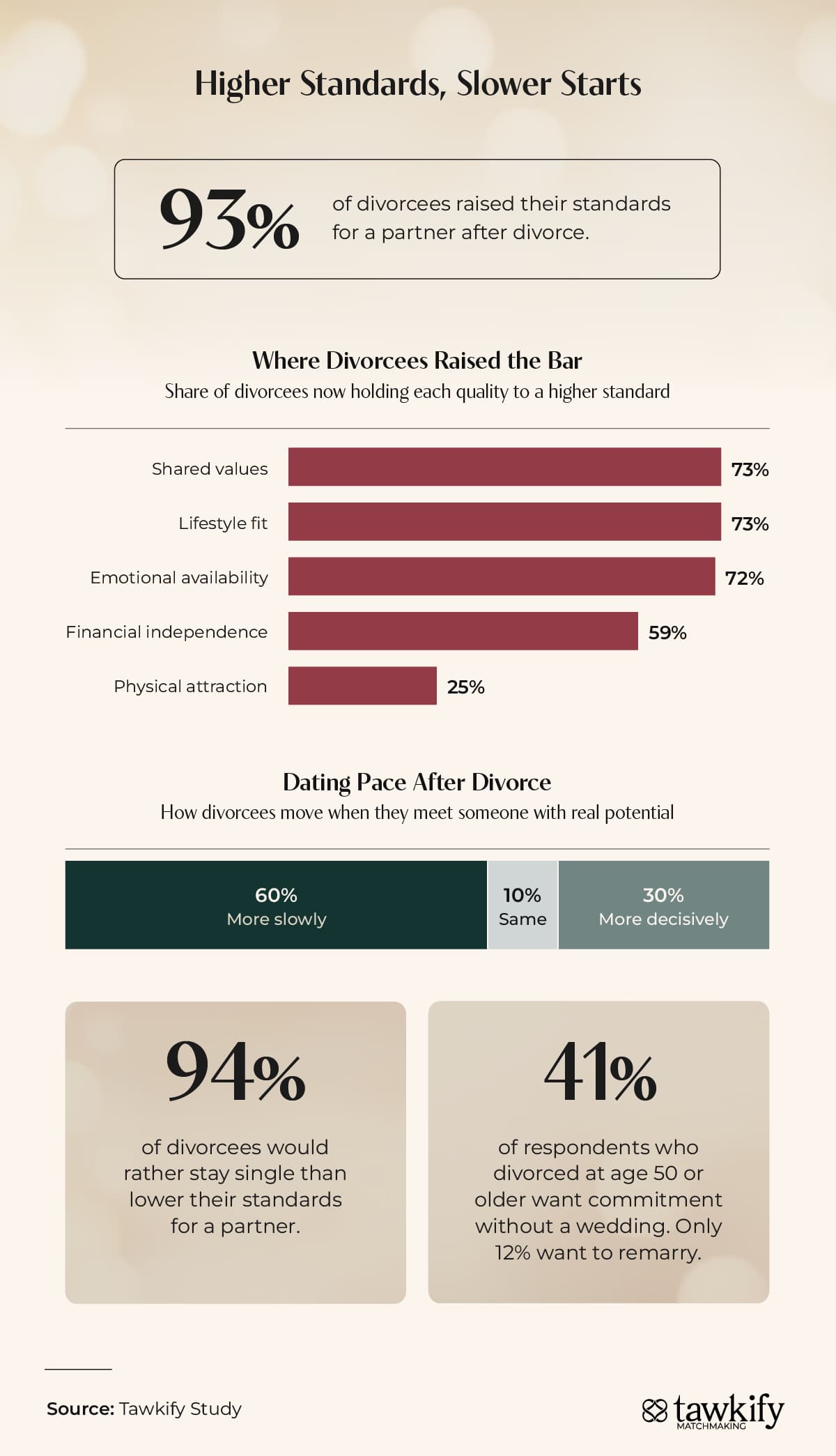
After a marriage falls apart, most divorced adults come back to dating with a clearer picture of what they want and far less patience for what they don’t. Among divorced adults, 93% said they raised their standards in at least one area after their split.
Tawkify surveyed 827 divorced adults in their 40s, 50s, and 60s to see how a previous marriage changes the search for the next one. The answers point to higher standards, slower timelines, a fresh set of dealbreakers, and a divide over whether marriage is even the goal anymore.
Key Takeaways
- 75% of divorced adults feel happier after divorce, but only 35% feel more confident dating.
- More than 9 in 10 divorced adults would rather stay single than lower their standards for a partner.
- 60% of divorced adults take things more slowly with a promising match after divorce.
- Among adults who divorced at 50 or older, 41% want commitment without marriage, while just 12% want to remarry.
- Just 21% of divorced adults would remarry freely. Another 43% would only under certain conditions, with the top one being a long stretch of dating first (71%).
In this article
After Divorce, Daters Raise the Bar and Slow Things Down
A previous marriage seems to teach divorced daters exactly what they will no longer accept.
Standards Went Up Almost Across the Board
Most divorced adults (93%) have raised their standards in at least one area after their divorce, and women are more likely to push theirs higher than men (95% vs. 86%). Here’s where the bar rose the most:
- Shared values (73%)
- Lifestyle compatibility (73%)
- Emotional availability (72%)
- Financial independence (59%)
- Physical attraction (25%)
The New Dealbreakers
Poor communication has become the fastest way to end things before they start (63%), edging out dishonesty and controlling behavior (both at 60%). The rest of the dealbreaker list includes:
- Emotional unavailability (57%)
- Heavy drinking or substance use (56%)
- Unwillingness to compromise (56%)
- Financial irresponsibility or debt (55%)
- Different core values (52%)
- Being a poor listener (49%)
- Lack of ambition (43%)
- Different views on family or children (37%)
A Slower, More Deliberate Pace
Most divorced adults are in no rush, and they would rather wait than settle:
- 60% take things more slowly now with a promising match, and only 30% move more decisively.
- Caution rose with age, climbing from 54% of millennials to 64% of baby boomers.
- 94% would rather stay single than compromise their standards, and women hold the line harder than men (96% vs. 88%).
Commitment, but Not Always Marriage
A ring is no longer the finish line for many divorced adults:
- Commitment without marriage beats marriage nearly 3-to-1: 43% want a partner without a wedding, compared with 15% who want to marry.
- Baby boomers lead the shift, with 52% wanting commitment without remarriage and just 9% wanting marriage.
- Among those who were 50 or older at their most recent divorce, 41% want a partnership without the paperwork, and only 12% want a wedding.
When you’re looking for a relationship, there’s no comparison
Tired of swiping with no real connections? Tawkify takes a fresh approach to the process. With handpicked matches tailored just for you and personalized introductions, we do the work so you can focus on what matters — meaningful connections.
- 80% of people find success with Tawkify
- 3 Million+ relationship-ready singles
- 200,000 Successful connections and counting
The Lessons That Follow Divorce
Starting over brought a mix of relief and caution for divorced adults.
Freer and Happier, but Less Sure
Divorce lifted a weight for most people, even if confidence took longer to return:
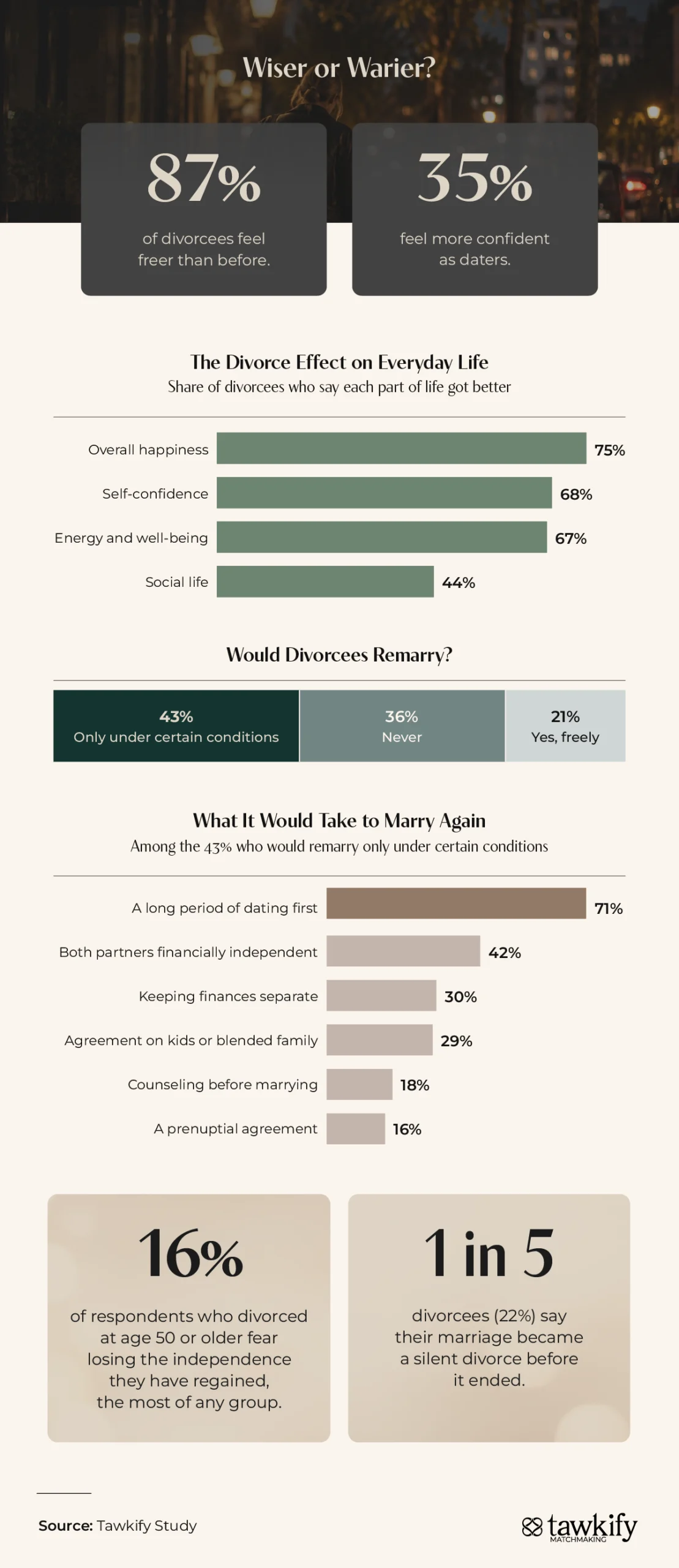
- 87% of divorced adults feel freer after divorce, and 75% feel happier.
- Only 35% feel more confident dating, and 29% feel less confident.
- Among those divorced at 50 or older, 91% say they feel freer.
The Red Flags They Missed
Hindsight sharpened what divorced adults watch for now:
- Dishonesty is the red flag most say they missed the first time (22%), ahead of controlling behavior (13%) and love bombing (12%).
- Infidelity ended 41% of these marriages.
- 22% say their marriage had become a “silent divorce,” turning into roommates before it formally ended, rising to 28% among those divorced at 50 or older.
What Worries Them Now
When asked what scares them about being single, the most common answer was nothing (24%). For those who named a fear, the top responses are:
- Ending up alone (19%)
- Ending up in the wrong relationship again (16%)
- Never feeling a real connection again (10%)
Dating again carried its own worries:
- Half of divorced daters (50%) fear being deceived about who someone really is.
- 14% worry about being scammed or catfished for money.
- Women are four times more likely than men to worry about their safety when meeting someone new (29% vs. 7%).
Would They Marry Again?
For many divorced adults, a second wedding is a maybe at best:
- Only 21% of divorced adults would remarry with no conditions. Another 43% would remarry only under certain conditions, while 36% of divorced adults would not remarry at all.
- Women are more done with marriage than men: 38% vs. 30% would never remarry.
- 39% of people divorced at 50 or older say they wouldn’t remarry, rising to 42% of among women in this group.
Among the 43% who would remarry only under conditions, patience topped the list:
- A long dating period first (71%)
- Both partners are financially independent (42%)
- Keeping finances separate (30%)
- Agreement on children or a blended family (29%)
- Counseling before marrying (18%)
- Using a prenuptial agreement (16%)
Across all divorced adults, the same conditions rank in the same order:
- A long dating period (31%)
- Both partners being financially independent (18%)
- Keeping finances separate (13%).
Methodology
For this campaign, we surveyed 827 divorced adults in the United States about how they approach dating and relationships after a first marriage ends. Respondents ranged in age from 40 to 69, with an average age of 53.
By generation, the sample broke down as follows: Millennials (ages 40 to 45) accounted for 22% (178 people), Gen X (ages 46 to 61) made up 62% of respondents (511 people), and baby boomers (ages 62 and older) made up 17% (138 people).
Within the sample, 20% were 50 or older when their most recent divorce occurred. Years since divorce were derived from each respondent’s current age and their age at divorce. The sample skewed female at 76%, with 24% male, which is consistent with women initiating the majority of divorces in this age group.
Demographic breakdowns are reported only for subgroups that represent at least 5% of respondents. Percentages are rounded to the nearest whole number, and questions allowing more than one answer may total more than 100%. Averages for numeric questions were calculated both with and without outliers, using the interquartile range method.
Data was collected through CloudResearch Connect and Prolific in August and September 2026. Respondents who did not complete the survey or failed attention checks were excluded from the final results.
About Tawkify
Tawkify is one of the country’s largest matchmaking services, offering a human-first alternative to dating app burnout through expert-curated matches built for long-term compatibility. Every client works with a matchmaker who gets to know them personally and draws from a private network of more than 3 million relationship-ready singles, an approach that has led to more than 200,000 successful connections. For anyone rethinking what they want after a divorce, Tawkify’s matchmakers lead with compatibility, so the next relationship has a foundation to last.
Fair Use Statement
The findings above are free to share for noncommercial purposes. We only ask that you link back to this page to credit Tawkify’s research and so your readers can explore the full study.