Dating With an Audience: How Kids Shape Their Parents’ Love Lives After 40


Dating after 40 often comes with a built-in review panel. Teenagers still living at home and grown kids with lives of their own tend to have opinions about who Mom or Dad is seeing, and plenty of parents take those opinions seriously. A new partner may need to win over the kids before the relationship gets very far.
To see how much weight kids’ opinions carry, Tawkify surveyed 733 parents ages 40 to 69 who are single, dating, or have dated since turning 40. We asked how their children have reacted to new partners, what worries came up, and how often a child’s disapproval changed where a relationship went next.
Key Takeaways
- About 3 in 4 parents 40+ (76%) have changed the course of a romantic relationship because their children disliked a partner.
- More than a third (36%) of parents 40+ have ended or avoided pursuing a relationship because their children disapproved.
- Over 1 in 4 (27%) parents 40+ have hidden or downplayed a relationship from their children.
- Even among parents who say their kids have no influence over whom they date, 43% have still changed a relationship because of them.
- More than 2 in 5 parents 40+ (44%) say their children have Googled, searched social media for, or otherwise investigated someone they were dating.
- Nearly 9 in 10 (87%) parents 40+ say finding someone who fits their family is as important as finding someone compatible with them.
- Trustworthiness is the No. 1 concern children raise about a parent’s partner (44%).
In this article
How Much Say Kids Get in Their Parents’ Love Lives
For many parents over 40, a child’s thumbs-down carries real weight, and it changes how relationships move forward.
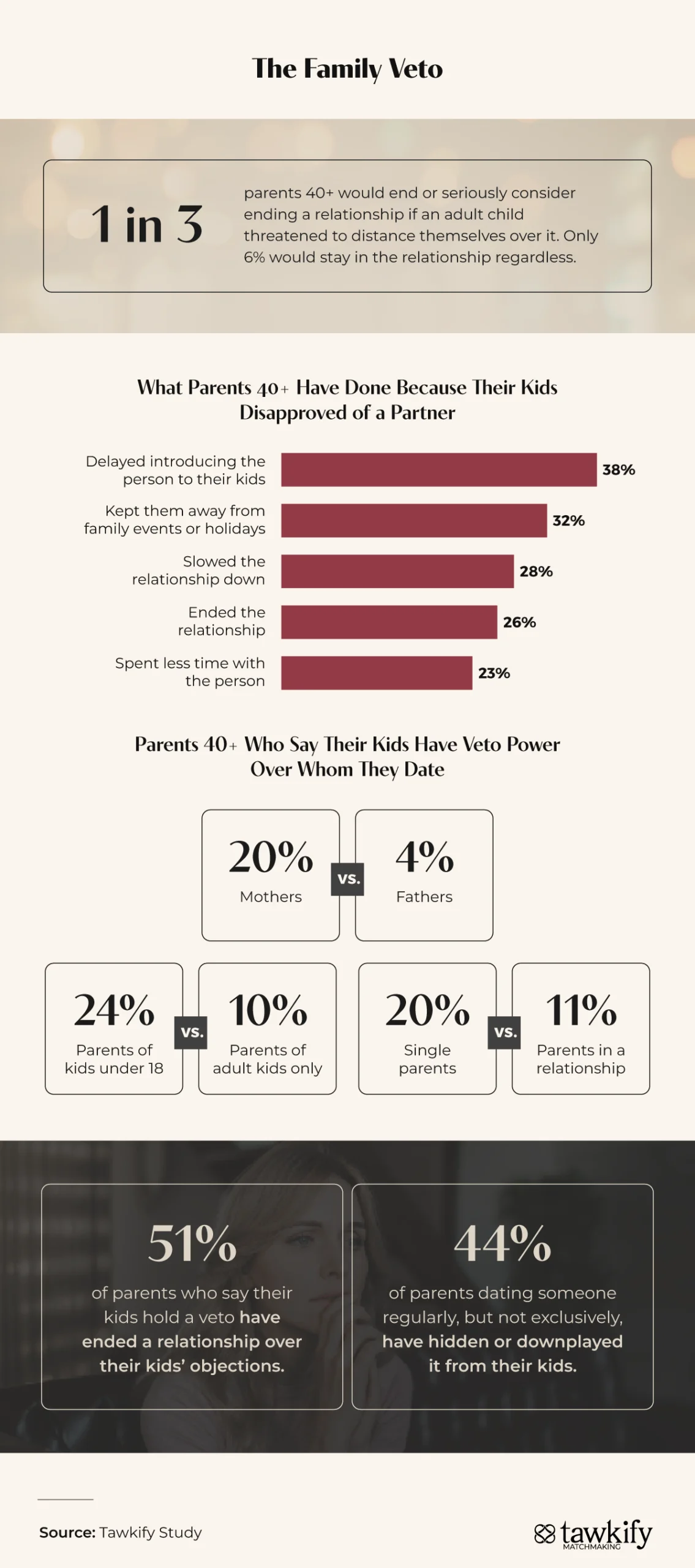
Here’s how often kids’ opinions steered their parents’ dating decisions:
- Disapproval changed the course. 76% parents 40+ changed the course of a romantic relationship because their children disliked a partner, and 36% ended or avoided pursuing a relationship because their kids disapproved.
- Even “no influence” had influence. Among parents who said their kids had no say over whom they dated, 43% still changed a relationship because of them.
- Kids’ approval weighed heavily. 2 in 5 parents (40%) said their children’s approval strongly influenced or decided whom they dated, including 17% who said their kids effectively held a veto. Another 44% said their kids had some influence, while 17% said they had none.
- An adult child’s ultimatum could end things. 1 in 3 parents with an adult child (34%) said they would end or seriously consider ending a relationship if that child threatened to distance themselves over it. Nearly half (47%) would slow things down to work through the child’s concerns, 13% would continue but keep the child and partner apart, and only 6% would carry on regardless.
- A veto usually meant business. Among parents who said their kids held a veto, 51% had ended a relationship over their kids’ objections.
- Mothers gave their kids far more say than fathers did. Mothers were five times as likely as fathers to say their kids held a veto (20% vs. 4%) and nearly twice as likely to have ended a relationship over their kids’ objections (29% vs. 16%). Fathers were more than three times as likely to stay in a relationship despite an adult child’s ultimatum (14% vs. 4%).
- Younger parents and families with kids at home gave children the most influence. Among parents in their 40s, 22% said their kids held a veto, compared with 5% of parents in their 60s. Parents with at least one child under 18 were more likely than parents of only adult children to say the same (24% vs. 10%). 34% of parents with a child living at home had ended a relationship over their kids’ objections, compared with 20% of those without kids at home.
- Single parents gave their kids more say than partnered parents. 1 in 5 single parents (20%) said their kids held a veto, compared with 11% of parents in a relationship. Among parents dating someone regularly but not exclusively, 44% had hidden or downplayed the relationship from their kids, and 45% had kept the person away from family events or holidays.
When you’re looking for a relationship, there’s no comparison
Tired of swiping with no real connections? Tawkify takes a fresh approach to the process. With handpicked matches tailored just for you and personalized introductions, we do the work so you can focus on what matters — meaningful connections.
- 92.1% of people find success with Tawkify
- 3 Million+ relationship-ready singles
- 200,000 Successful connections and counting

The Kids Are Running Background Checks on Mom and Dad’s Dates
Before a new partner ever sits down for a family dinner, there’s a good chance the kids have already looked them up.

Here’s what the family approval process looked like for parents over 40:
- Most kids did their homework. Close to 2 in 3 parents 40+ (63%) said their children had vetted someone they were dating, and 44% said their kids had Googled, searched social media for, or otherwise investigated a date. The most common vetting moves:
- Asked about the person’s intentions (35%)
- Searched their social media (31%)
- Questioned or “interviewed” them directly (24%)
- Googled them (21%)
- Asked relatives or friends about them (16%)
- Warned the parent about something they found (16%)
- Looked into their career or background (13%)
- Bigger families meant more sleuthing. Among parents with 3 or more kids, 54% said a child had investigated someone they were dating, compared with 33% of parents with 1 child.
- Kids’ worries changed as their parents got older. Concerns about changes at home dropped from 33% among parents in their 40s to 17% among parents in their 60s, while worries about money, assets, or inheritance rose from 12% to 18%.
- The kids were often onto something. Half of parents (49%) whose kids raised concerns about a partner said their kids were right most of the time or always.
- Most parents welcomed a second opinion. 84% said having their kids’ support helped their relationships succeed, and 74% trusted their kids to spot red flags they might miss. Nearly 9 in 10 (87%) said finding someone who fit their family was as important as finding someone compatible with them. Only 16% said a child had tried to interfere with or break up a relationship.
- Meeting the kids took time. Parents 40+ typically waited 4 to 6 months before introducing a partner to their children.
- Mothers faced more scrutiny and moved more cautiously than fathers. Kids were more than twice as likely to warn mothers about something they discovered about a date (18% vs. 8%). Mothers were also more likely to wait until a relationship could become permanent before introducing a partner (18% vs. 10%), while fathers were more likely to make introductions within 3 months (32% vs. 19%).
Methodology
In October 2026, we surveyed 733 parents ages 40 to 69 who are currently single or dating, or who have dated since turning 40, using Prolific and CloudResearch Connect. Respondents were 77% women, 22% men, and 1% nonbinary, with an average age of 51. By generation, 29% were millennials, 57% were Gen X, and 14% were baby boomers. About half (49%) had at least one child under 18, and 51% had only adult children.
Questions about an adult child’s ultimatum were asked only of parents with at least one adult child (491 respondents). Questions about whether children’s concerns proved justified were asked only of parents whose children had raised a concern (544 respondents). The typical introduction timeline is the median among parents who gave a specific timeframe (446 respondents).
Generations were defined by age: millennials 30 to 45, Gen X 46 to 61, and baby boomers 62 and older. Percentages are rounded to the nearest whole number, and any that do not total 100% are due to rounding. Survey data relies on self-reporting and may be subject to exaggeration, recall bias, and other limitations. Results were not weighted.
About Tawkify
Tawkify offers a human-first alternative to dating apps, with expert-curated matches selected for long-term compatibility. Tawkify’s matchmakers get to know each client through video calls, search a private network of more than 3 million relationship-ready singles, and refine their search based on client feedback. Learn how Tawkifys matchmaking works, or request a call with a matchmaker to get started.
Fair Use Statement
You’re welcome to share these findings for noncommercial purposes. Please credit Tawkify and link back to this page.