The Dating Without Swiping Index


Singles are looking for new ways to meet people, and it shows in what they’re searching online. Searches for professional matchmakers have jumped 25% since 2022, and searches for dating coaches and dating services have gone up just as much.
Tawkify surveyed 631 U.S. singles ages 22 to 55 to see how they really want to meet someone, what bugs them most about dating apps, and what kind of help they’d actually pay for. Then we looked at nearly four years of Google search data across 150 U.S. cities to see if people’s real search habits match what they say.
Key Takeaways
- Among singles who used a dating app in the past year, 72% say they’re burned out, including 81% of women and 66% of men.
- 91% of current app users kept swiping even when they wanted to quit.
- 77% of singles have deleted all their dating apps at once before, and 54% did it in the past year alone.
- 69% of singles want to meet someone naturally in real life, and 81% didn’t even put dating apps in their top 3 ways to meet people.
- Friends beat algorithms: 19% of singles say they’d trust a close friend most to pick their next date; only 3% would trust an app.
- 2 in 5 singles looking for a relationship (40%) would rather have a few verified matches than sort through a massive pool of profiles themselves.
- Among full-time working singles, 73% took a break from dating in the past year because it felt like a second job.
In this article
Why So Many Singles Keep Swiping After They Want to Stop
Wanting off the apps and actually leaving them turned out to be two very different things.
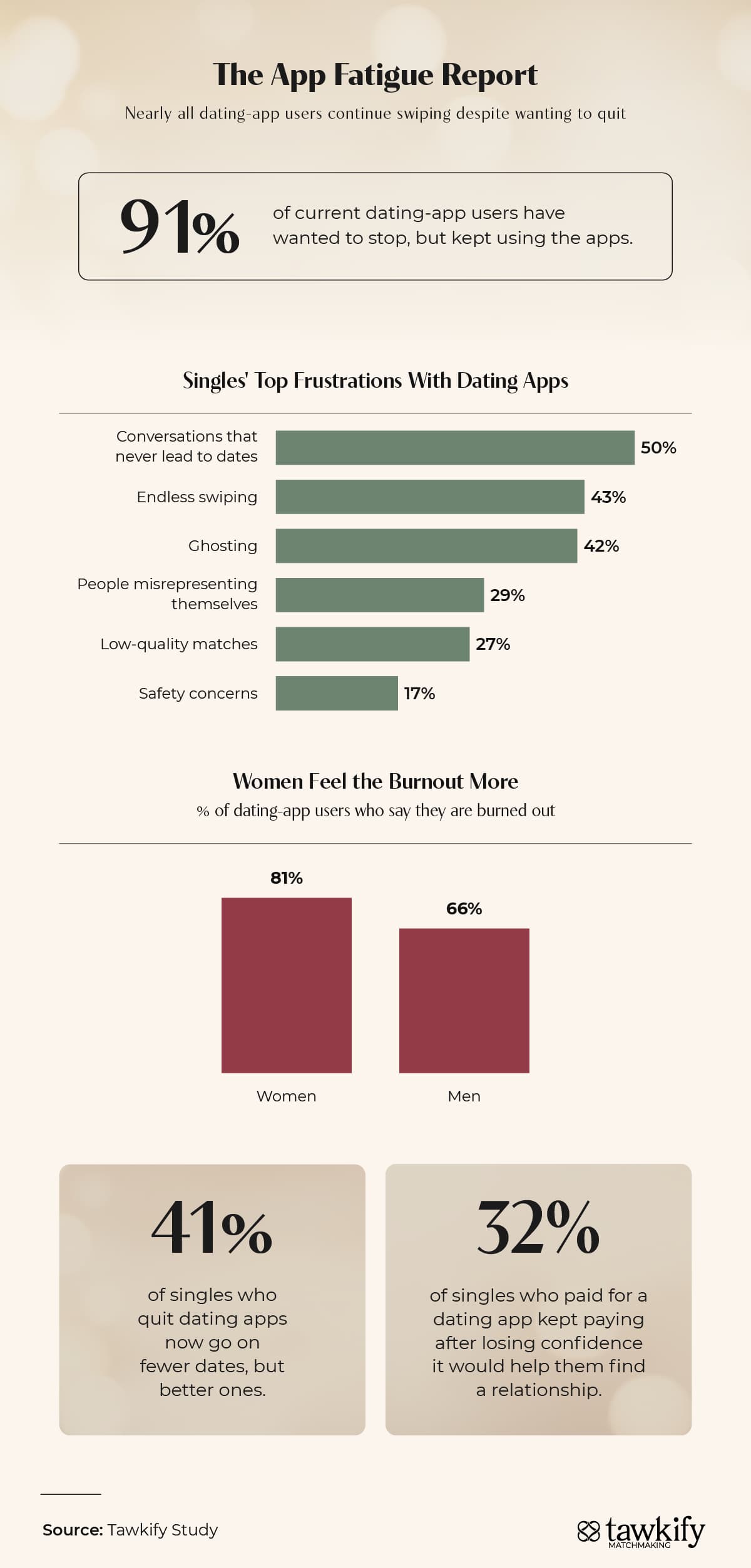
Most current app users we surveyed have hit a wall. Just over 9 in 10 wanted to stop but kept using the apps anyway, and 32% of singles who’ve paid for an app kept paying after losing confidence it would help them find a relationship. Burnout was widespread, too. Among singles who used an app in the past year, 72% said they’re burned out, and women felt it more than men (81% vs. 66%).
The biggest frustrations centered on things going nowhere. Half of app users named conversations that never lead to dates as a top frustration (50%), ahead of endless swiping (43%) and ghosting (42%). Plenty of singles have reached their limit at least once, with 77% saying they’ve deleted every dating app at once at some point, including 54% in the past year.
For those who walked away for good, the change paid off. Among singles who quit dating apps in the past year, 59% said their dates got better, and 41% now go on fewer dates, but better ones.
Singles Want Better Matches and a Say in Who They Date
When asked how they’d most like to meet someone, singles pointed to real life first.
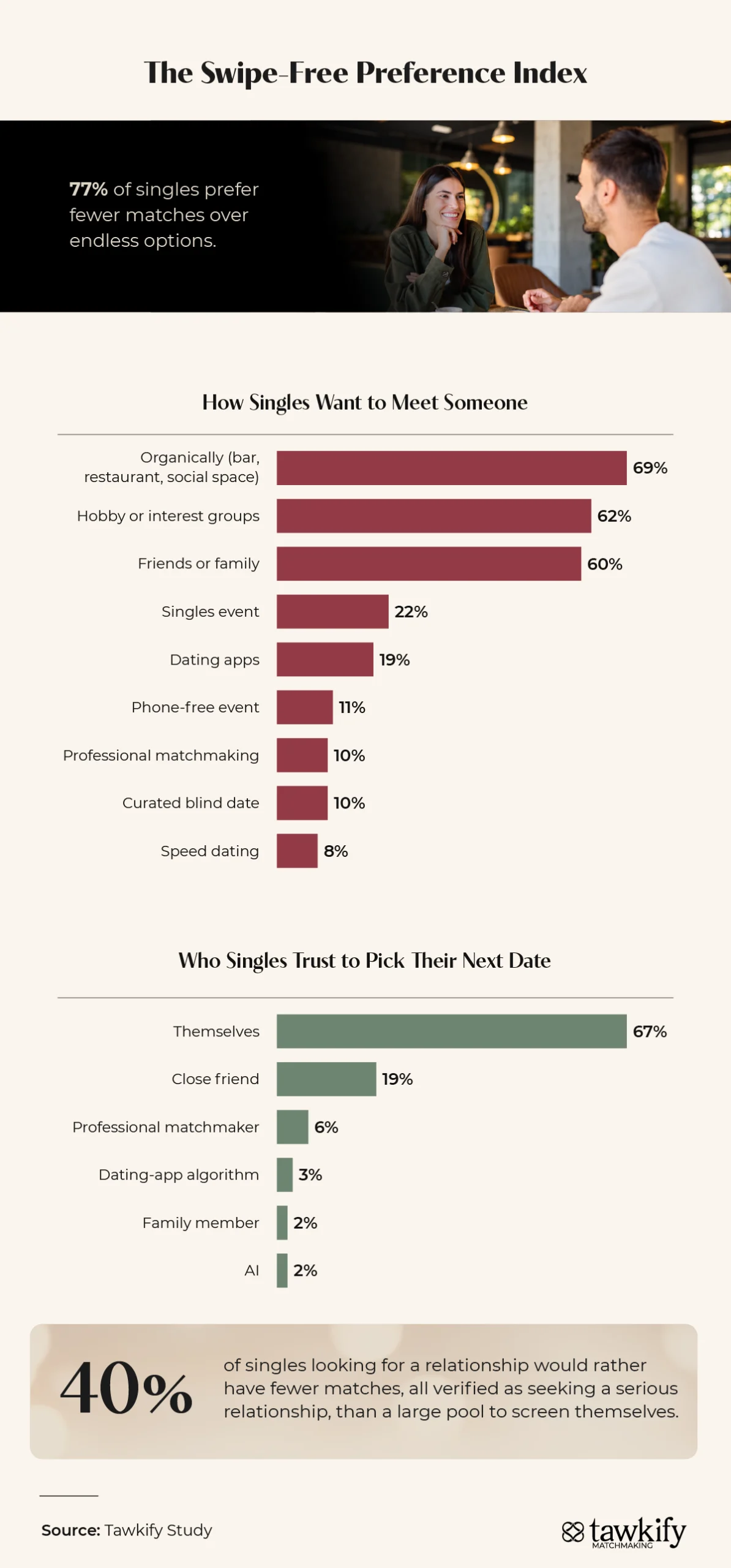
Meeting someone organically at a bar, restaurant, or social space topped the list (69%), followed by hobby or interest groups (62%) and introductions from friends or family (60%). Dating apps came in fifth, and 81% of singles left them out of their top 3 ways entirely.
Sheer volume has lost its appeal as well. More than 3 in 4 singles (77%) would rather have fewer matches than a large pool to screen. Among relationship-seeking singles, 40% want the same, as long as every match is verified as seeking a serious relationship.
Singles still want the final say, though. A majority (67%) trust themselves most to choose their next date, and a close friend came in second at 19%. Twice as many singles would trust a professional matchmaker to make that decision than a dating-app algorithm (6% vs. 3%).
When Dating Starts to Feel Like Work
For full-time professionals, the biggest obstacle to dating was the calendar.
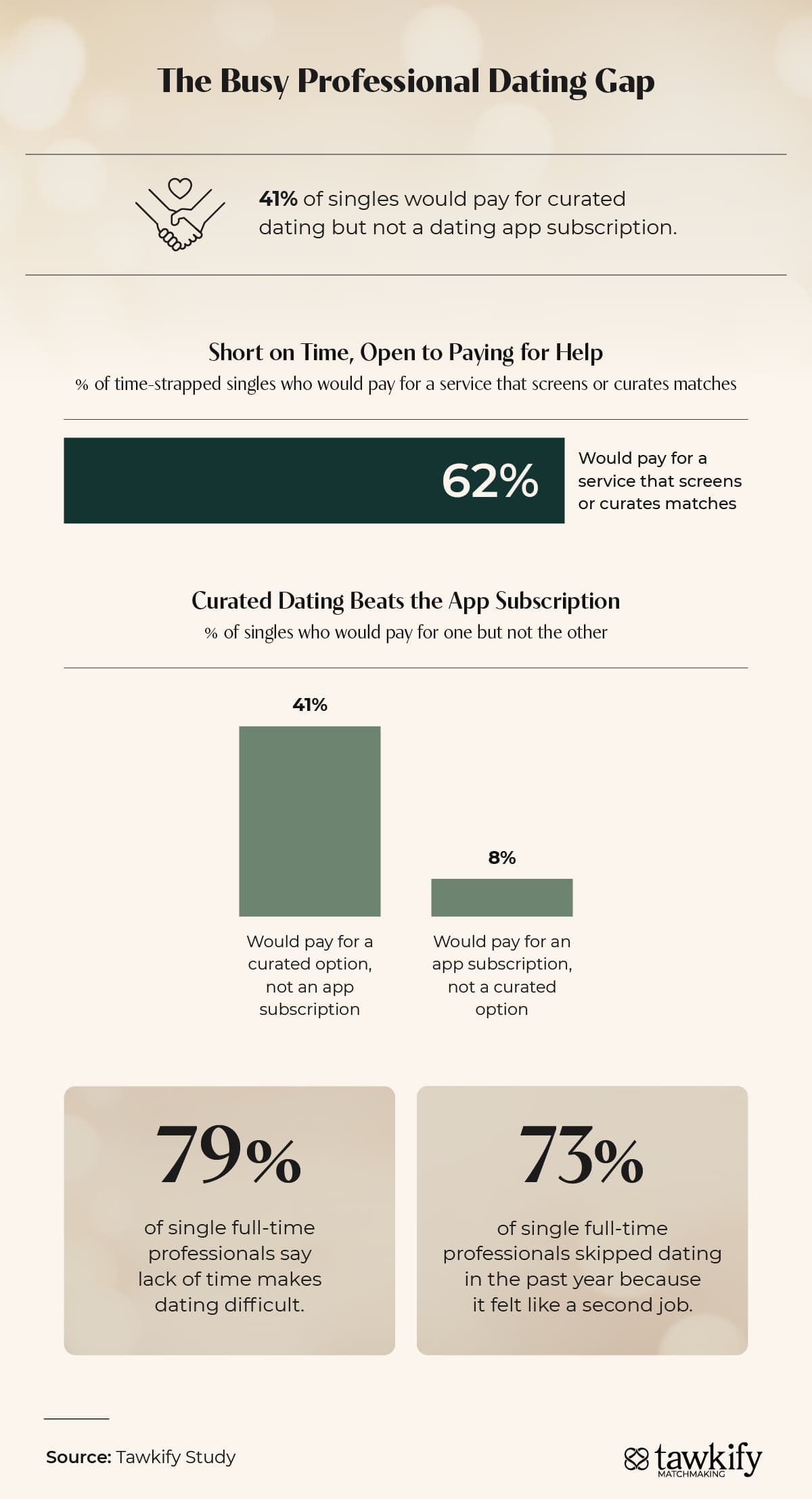
For many single full-time professionals (79%), time constraints present a major hurdle to dating. The burden leads many to pause their search altogether. Nearly half (47%) have taken multiple breaks from dating after it began to feel like extra work, and 73% opted out of dating in the last year because it felt like a second job.
Singles were far more willing to pay for curation than for access. About half (51%) would pay for a curated dating option, and 41% would pay for a curated option, but not an app subscription. That’s five times the share of those who’d pay for an app subscription, but not for a curated option (8%).
Among singles who said a lack of time makes dating difficult, 62% would pay for a service that screens or curates matches. And nearly 1 in 4 relationship-seeking singles (24%) would pay for a one-time vetted introduction while passing on an app subscription.
When you’re looking for a relationship, there’s no comparison
Tired of swiping with no real connections? Tawkify takes a fresh approach to the process. With handpicked matches tailored just for you and personalized introductions, we do the work so you can focus on what matters — meaningful connections.
- 92.1% of people find success with Tawkify
- 3 Million+ relationship-ready singles
- 200,000 Successful connections and counting

Search Data Shows Singles Looking for Expert Help
What people type into Google late at night tells the exact same story. Singles are actively looking for a way out of the swipe cycle.
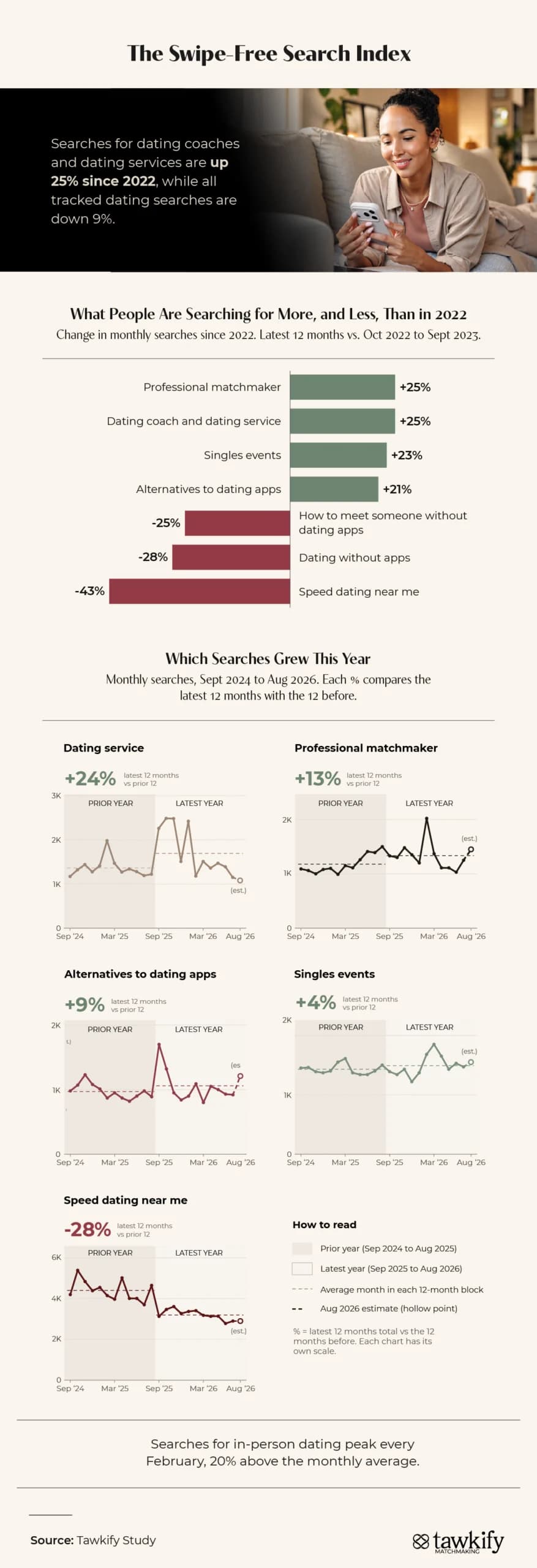
Searches for dating coaches and dating services rose 25% (from 54,430 to 67,915), and searches for “professional matchmaker” grew 25% as well (from 12,830 to 16,000). Searches for “alternatives to dating apps” climbed 21%, and they peak every September and October, at 13% and 10% above the monthly average.
Searches tied to finding dates on your own moved the other way. Searches for “speed dating near me” fell 43% (from 67,080 to 38,290), and searches for “dating without apps” dropped 28% (from 7,490 to 5,400), even though 69% of singles in our survey would most like to meet someone organically. In-person dating searches still spike each February, landing about 20% above the monthly average.
Where Interest in Matchmaking Is Climbing
While national search trends highlight a broader shift toward expert dating support, local search activity reveals clear regional hotspots for this demand. A handful of metropolitan areas stood out with dramatic surges in matchmaking interest and local searches.
| Metro | What we found |
|---|---|
| Orlando, FL | Matchmaking made up 14% of dating searches, and matchmaking searches rose 41% in a year. |
| McKinney, TX | About 1 in 4 (26%) dating searches were for matchmaking, the highest share among the 20 metros ranked. Matchmaking searches rose 43%. |
| Buffalo, NY | Matchmaking searches rose by 25% and accounted for 16% of dating searches. |
| Pittsburgh, PA | Matchmaking searches rose by 23% and accounted for 15% of dating searches. |
| Charlotte, NC; Cleveland, OH; and Columbus, OH | Searches for dating coaches and similar help rose 67%, 62%, and 60% since 2022, the three biggest gains among ranked metros. |
| Baltimore, MD | In-person dating searches fell 53% (from 3,800 to 1,770), the biggest drop we found. |
Less Volume, More Compatibility
Singles still want to find someone, but many are running out of patience with a process built on volume. Across our survey and search data, they leaned toward fewer and better-vetted introductions, more time meeting people in real life, and help that saves time without taking away their choice. If dating has started to feel like a second job, it may help to focus less on how many people you can match with and more on how compatible those matches are. Chemistry can fade, but compatibility tends to last.
Methodology
Tawkify surveyed 631 U.S. singles ages 22 to 55 online. The survey was fielded through Prolific and CloudResearch Connect in September and October 2026, and responses are unweighted. Each finding is based on the group named in its wording:
- All singles: 631
- Relationship-seeking singles: 429
- Dating-app users in the past year: 546 (200 women and 344 men)
- Current app users: 370
- Singles who quit apps in the past year: 176
- Singles who have paid for an app: 309
- Single full-time professionals: 444
- Time-strapped singles: 232
“Time-strapped singles” are respondents who said that a lack of time makes dating difficult “a great deal” or “a lot.” Percentages are rounded, and some questions allowed respondents to choose up to three answers, so totals may exceed 100%. Percentages that do not total 100% are due to rounding.
Search volumes are Google Ads estimates for 150 U.S. metros from October 2022 to August 2026. “Since 2022” compares the latest 12 months (September 2025 to August 2026) with the first 12 months (October 2022 to September 2023). Unusual one-month spikes were smoothed out, and August 2026 figures are estimates. National figures reflect the sum of the 150 metros, not a U.S. total. Metro rankings include only the 20 metros with at least 300 matchmaking searches.
About Tawkify
Tawkify is a human-first matchmaking service that replaces dating app burnout with expert-curated matches from a private network of more than 3 million relationship-ready singles. Clients meet their matchmaker over video calls, and the matchmaker searches for compatible matches and refines the search based on each client’s feedback. Learn more about how Tawkify matchmaking works today.
Fair Use Statement
You’re welcome to share these findings for noncommercial purposes. Please credit Tawkify and link back to this page so readers can see the full study.