Long Distance Dating Trends: How Far Singles Travel for Love

Long-distance dating used to sound like a last resort. Now, it’s a real option for people who care more about compatibility than proximity. To understand how Americans think about dating across city lines, Tawkify surveyed 1,000 single adults nationwide about their openness to long-distance relationships, how much effort and travel they’d be willing to take on, and what tends to happen when long-distance dating plays out in real life.
In this article
Key Takeaways
- Over 3 in 5 single Americans (65%) are open to dating someone long-distance.
- Over 4 in 5 singles (84%) would be willing to relocate for the right person.
- Over half of singles (56%) would date for a month or longer before meeting in person.
- Nearly half of Americans (47%) are willing to stay in a long-distance relationship for at least a year or longer before needing to live closer.
- 62% of Americans have dated someone long-distance (54% did so in the past, and 8% are currently in a long-distance relationship).
- More than 1 in 3 Americans (35%) trust long-distance relationships as much as local ones.
How Open Single Americans Are to Long-Distance Dating
Is love worth an hour-long drive or even a cross-country flight? As digital connection makes the world feel smaller, single Americans are expanding their geographical horizons like never before. The following survey data explores how different generations navigate the complexities of long-distance dating. Whether it’s Gen Z’s digital-first openness or the surprising number of singles ready to pack their bags for “The One,” these insights reveal a dating culture that refuses to let mileage stand in the way of a meaningful match.
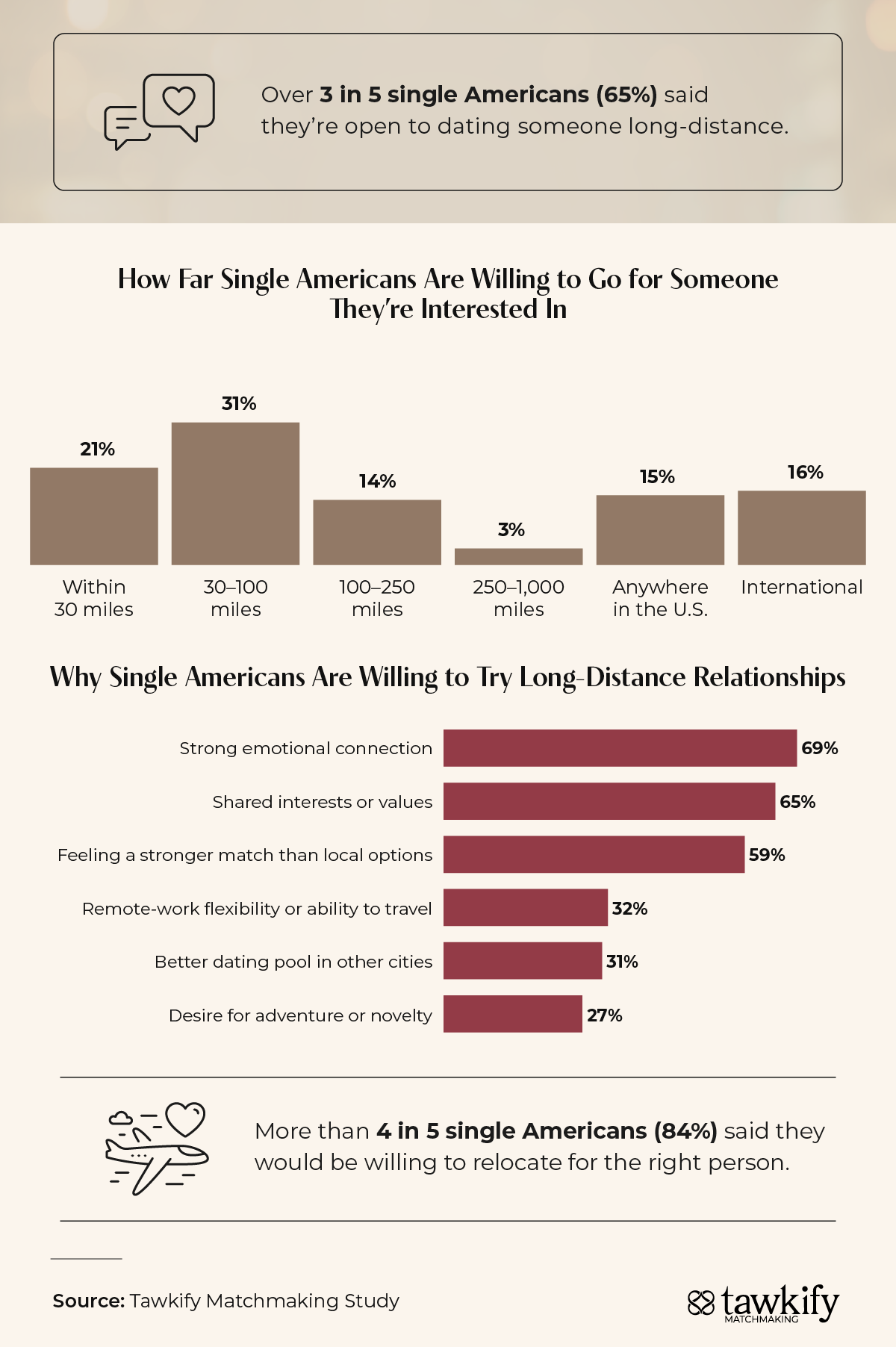
- Single millennials (68%) and Gen Z (64%) are far more open to long-distance dating than Gen X and older adults (54%).
- Nearly all generations are open to relocating for the right person: 85% of millennials, 85% of Gen Z, and 76% of Gen X and older adults said they would move for a meaningful relationship.
- About 1 in 3 single Americans (35%) said they trust long-distance relationships just as much as local ones, including 41% of millennials, 35% of Gen X and older adults, and 33% of Gen Z.
- 40% of single Americans expect to communicate with a long-distance partner multiple times per day, while another 26% are comfortable with a few check-ins per week, and 25% expect daily communication. Only 7% have no specific expectations.
- Openness to international dating varies by age group, with 19% of millennials, 16% of Gen Z, and 11% of Gen X and older generations saying they would consider dating someone internationally.
Mindsets About Long-Distance Dating
While the idea of long-distance love is more accessible than ever, individual openness remains a spectrum of caution and curiosity. Tawkify’s survey reveals that while many singles require an “exceptional” connection to bridge the gap, a significant portion remains cautiously optimistic about pursuing love beyond their zip code.
- 39% — I’d only try it for someone exceptional.
- 35% — I’m open but cautious.
- 12% — It’s a fun possibility.
- 8% — I’ve been burned before, but would try again.
- 6% — Never again
The Rules, Risks, and Realities of Long-Distance Dating
Maintaining a connection across state lines or oceans requires more than just emotional chemistry. Once distance is on the table, expectations around time, effort, and cost quickly come into focus, often acting as the ultimate test of a couple’s commitment. Understanding these practical boundaries is essential for any single American looking to turn a remote spark into a lasting flame.
What Single Americans Are Willing to Do for a Highly Compatible Long-Distance Match
- 69% — Take turns visiting
- 59% — Travel to their city
- 51% — Host them in their own city
- 39% — Begin with virtual-only dates
- 34% — Start with a planned timeline to eventually live in the same place
- 30% — Share travel costs
How Long Single Americans Would Date Long-Distance Before Meeting in Person
- Up to 1 week: 5%
- Up to 1 month: 27%
- 2–3 months: 30%
- 4–6 months: 15%
- Longer than 6 months: 6%
- Comfortable not meeting for a while: 5%
- Would not date without meeting soon: 11%
Biggest Dealbreakers in a Long-Distance Romance
- 56% — Not enough effort from the other person
- 47% — Lack of communication
- 31% — Not knowing their real intentions
- 20% — Travel or financial burden
- 16% — Unclear timeline to close the distance
- 13% — Different work schedules or lifestyle
- 8% — Family or cultural differences
How Many Trips Single Americans Are Willing to Take Each Year for a Long-Distance Partner
- 1–2 trips: 12%
- 3–5 trips: 41%
- 6–10 trips: 24%
- More than 10 trips: 23%
How Much Single Americans Are Willing to Spend Per Trip to See a Long-Distance Partner
- Less than $50: 10%
- $50–$150: 27%
- $150–$300: 33%
- $300–$600: 21%
- Over $600: 9%
How Long Single Americans Are Willing to Stay in a Long-Distance Relationship Before Needing to Live Closer
- 1–2 months: 4%
- 3–5 months: 11%
- 6–9 months: 18%
- 10–12 months: 18%
- 1–2 years: 29%
- More than 2 years: 9%
- Would not need to live closer for relationship to continue: 9%
- Would never be willing to close the distance: 3%
When you’re looking for a relationship, there’s no comparison
Tired of swiping with no real connections? Tawkify takes a fresh approach to the process. With handpicked matches tailored just for you and personalized introductions, we do the work so you can focus on what matters — meaningful connections.
- 80% of people find success with Tawkify
- 3 Million+ relationship-ready singles
- 200,000 Successful connections and counting
Who Tries Long-Distance Dating and How It Actually Plays Out
For many Americans, long-distance dating isn’t just a hypothetical scenario. It’s a lived reality unique timelines and challenges. The survey data below illustrates how different generations approach the “miles apart” lifestyle and what ultimately happens when distance becomes part of the daily routine.
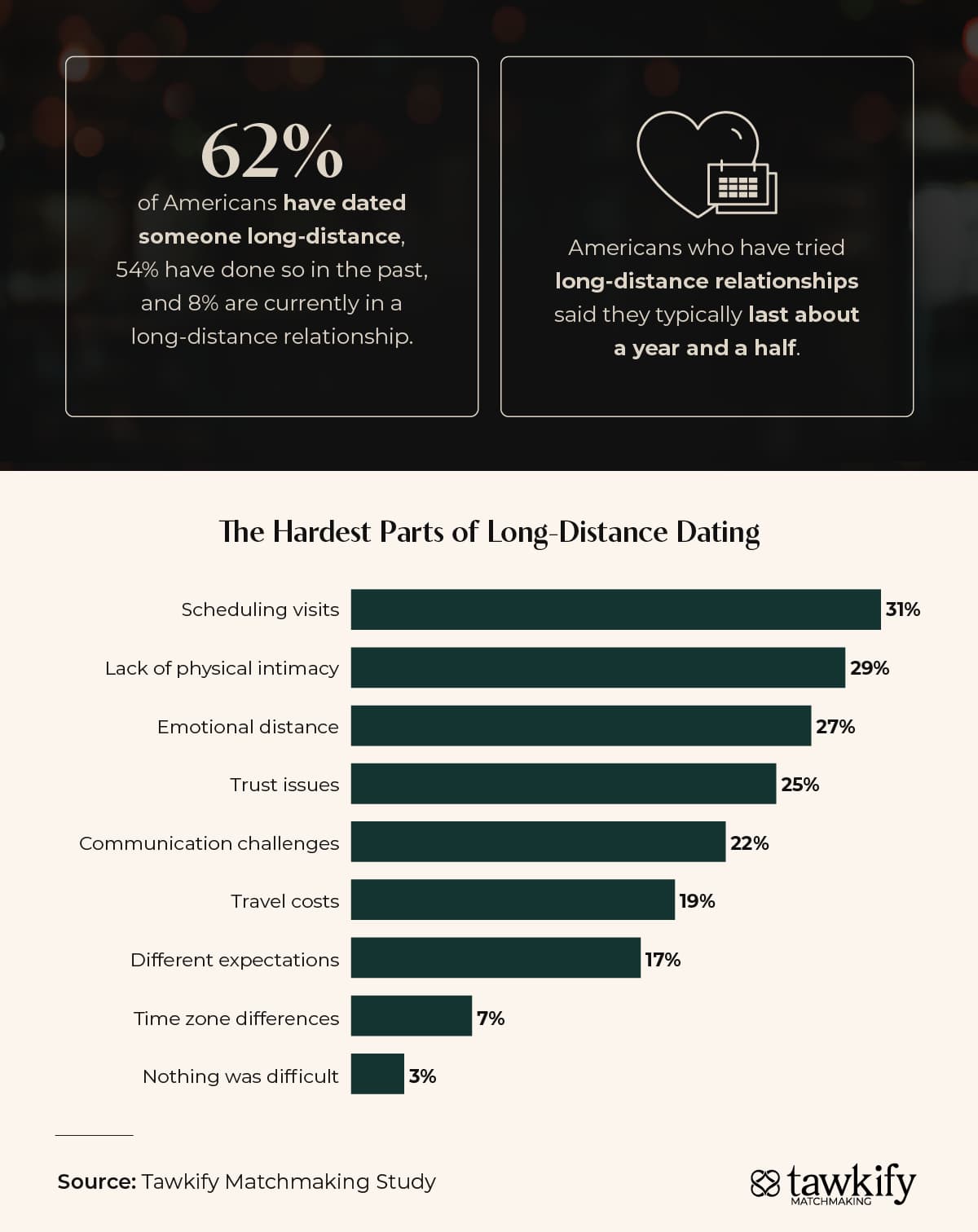
Millennials are the most likely to have dated someone in another city (60%), followed by Gen X and older adults (57%) and Gen Z (43%). Gen Z, however, is the most likely to be currently in a long-distance relationship (11%), compared to 6% of Gen X and 6% of millennials.
How Long-Distance Relationships Typically Start
- 26% — Met through social media
- 19% — Met in person while one partner was visiting
- 16% — Matched on a dating app by choice
- 16% — Introduced by mutual friends
- 15% — Other circumstances
- 6% — Met through a dating service
- 2% — Matched while one partner was traveling
- On average, single Americans in long-distance relationships lived about 300 miles apart.
- Gen X and older generations reported the longest average long-distance relationships, lasting about 24 months, longer than millennials (16 months) and Gen Z (14 months).
- Over half of single Americans (52%) reported that their long-distance relationship ended, but it was still a positive experience, while 35% described the ending as negative. More than 1 in 10 (14%) said it grew into a long-term relationship.
Conclusion: Bridging the Gap
Ultimately, long-distance dating is a testament to the lengths to which we are willing to go for a genuine connection. While the miles present logistical hurdles and require a higher level of trust and communication, the high success rate of relocation and the prevalence of positive outcomes suggest that for the right person, the distance is simply a temporary detail. The data is clear: true compatibility knows no borders.
Methodology
Tawkify surveyed 1,000 single Americans about their experiences with and attitudes toward long-distance dating. The average age of the respondents was 34; 50% were women, 47% were men, and 3% identified as non-binary. The sample consisted of 16% of Gen X and older generations, 48% millennials, and 35% Gen Z. Some percentages in this study may not total 100% due to rounding. Get the full rundown from Tawkify surveys and learn more of the latest dating trends.
About Tawkify
Since 2012, Tawkify has revolutionized the matchmaking industry by blending human intuition with data-driven insights. With a private database of over 1 million people and a track record of more than 200,000 successful matches, Tawkify offers a personalized, expert-guided alternative to today’s dating scene. Tawkify matchmakers handle everything from finding potential matches to planning unique and engaging dates, empowering clients to focus solely on building genuine connections.
Fair Use Statement
If you’d like to share this data for noncommercial purposes, please include proper attribution with a link back to Tawkify.