The Timeline Tangle: Are Modern Couples Agreeing on the Same Milestones?


Most couples assume they’re building toward the same future. But when it comes to timelines around marriage, moving in together, finances, or long-term commitment, assumptions can replace actual conversations. That gap between what partners want and what they think their partner wants may be creating more tension than many couples realize.
To explore how modern relationships navigate these expectations, Tawkify surveyed 1,009 American couples across generations and relationship stages. The findings revealed that while most couples feel aligned on the future, many have already experienced painful moments where hidden mismatches came to light too late.
Key Takeaways
- 80% of partnered Americans say they are on the same page as their partner about the future. However, 39% have already learned, in a current or past relationship, that they were wrong.
- 29% of American couples have assumed their partner wanted to get married when they didn’t, or vice versa. They never asked, they just assumed.
- Nearly 1 in 5 American couples (18%) say there is a relationship milestone they want that they haven’t told their partner about yet. Men are close to twice as likely as women to admit it (24% vs. 14%).
- 65% of American couples would consider ending a relationship over a major timeline mismatch. Gen Z (80%) are the most likely to say so.
- 31% of American couples say merging finances now feels more meaningful than marriage or engagement.
In this article
Where Modern Couples Get Each Other Wrong
Many relationships run on unspoken expectations. Even when couples feel emotionally connected, future plans can stay surprisingly undefined until a disagreement forces the conversation into the open.
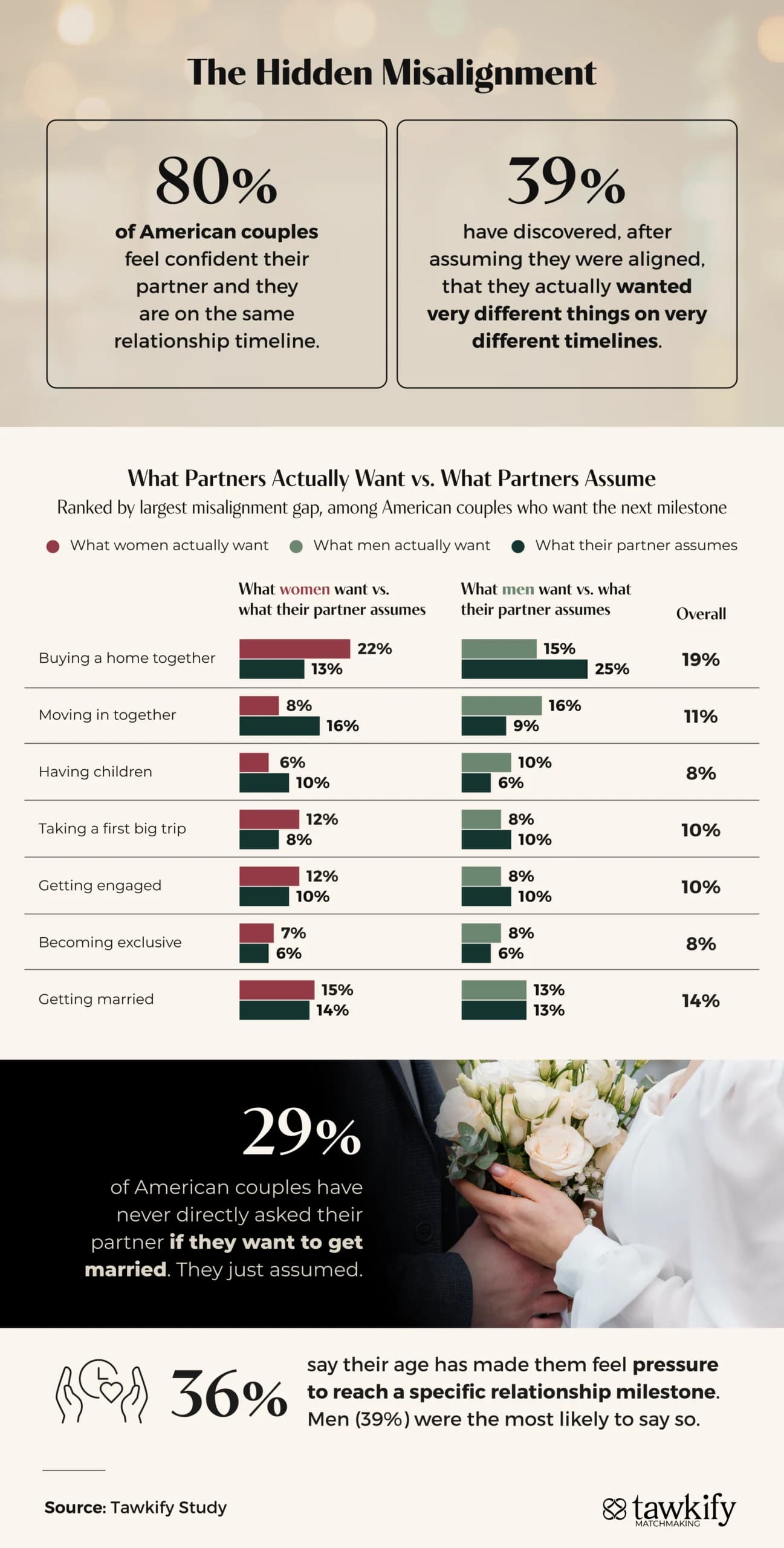
Most Americans in relationships believed they were aligned with their partner about the future, with 80% saying they felt confident they were on the same timeline. Still, confidence didn’t always translate into reality. Nearly 4 in 10 Americans (39%) said they later discovered they and their partner actually wanted very different things on very different timelines. Here’s how each generation reported discovering a timeline mismatch:
- Gen X (45%)
- Millennials (38%)
- Gen Z (38%)
- Baby boomers (23%)
Marriage expectations were one of the clearest examples of assumption replacing communication. Nearly 3 in 10 Americans (29%) admitted they assumed their partner wanted marriage when they didn’t, or vice versa, without ever directly discussing it. That finding highlights how often couples interpret signals instead of having explicit conversations about long-term goals.
Pressure around timing also shaped how people approached relationship milestones. Nearly 3 in 10 Americans (28%) said they felt a sense of urgency or a “biological clock” around reaching a specific milestone. Men were slightly more likely than women to feel this pressure (30% versus 27%). Gen Z respondents reported the strongest sense of urgency overall at 30%, compared with 23% of Gen X and 22% of baby boomers.
Some desires remained entirely unspoken. Nearly 1 in 5 Americans (18%) said there was a relationship milestone they wanted but had not yet told their partner about. Men were significantly more likely to keep these milestones private, with 24% saying they had not told their partner, compared with 14% of women.
Redefining the Serious Relationship
Commitment today looks different than it did for previous generations. Many couples are redefining what makes a relationship feel meaningful, stable, and fully committed beyond traditional milestones alone.
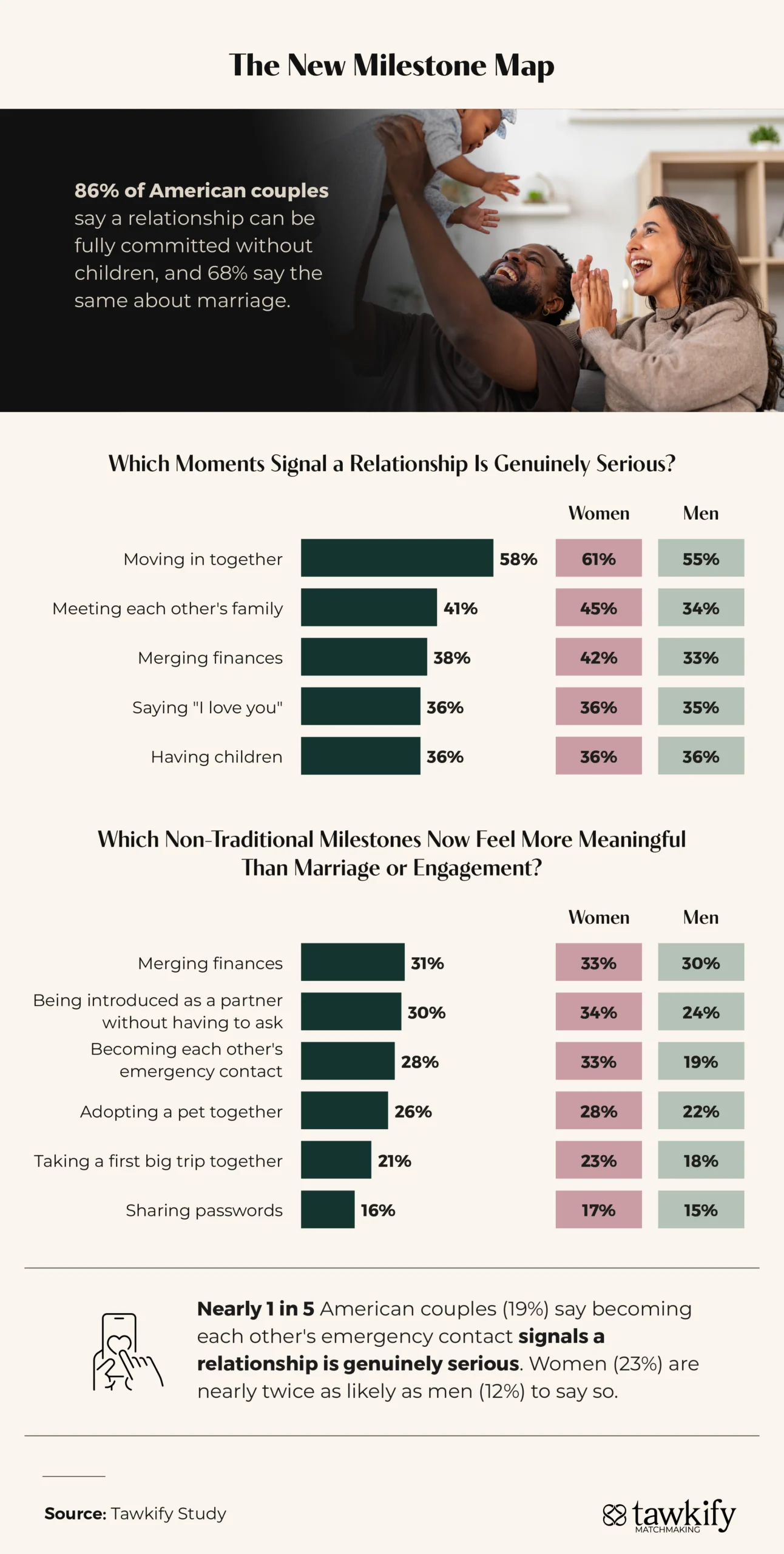
Most Americans believed a relationship could be fully committed without children. Overall, 86% agreed parenthood was not necessary to define a serious partnership. Gen Z respondents were the most likely to feel this way at 89%, followed by 86% of millennials, 84% of Gen X, and 77% of baby boomers.
Marriage itself no longer carried the same universal meaning across generations. While 68% of Americans overall said a relationship could be fully committed without marriage, only half of baby boomers agreed. Gen X aligned exactly with the national average at 68%, showing how ideas about commitment continue to shift between generations.
Shared living arrangements also carried emotional weight for many couples. More than half of Americans (58%) said moving in together signaled a relationship was genuinely serious. Younger generations felt this most strongly, including 62% of Gen Z and 61% of millennials, compared with 55% of Gen X and 43% of baby boomers.
For some couples, practical partnership mattered more than symbolic gestures. More than a quarter of Americans (26%) said adopting a pet together felt more meaningful than marriage or engagement. Gen Z stood out again, with 36% saying a shared pet represented deeper commitment, compared with 24% of both millennials and Gen X and 12% of baby boomers.
Finances emerged as one of the strongest modern relationship markers. Nearly 1 in 3 Americans (31%) said merging finances felt more meaningful than marriage or engagement. Millennials were the most likely to say so at 34%, followed by 31% of Gen X and 29% of Gen Z. Baby boomers were the only generation where fewer than 1 in 5 respondents (17%) viewed financial merging as more meaningful than marriage itself.
When you’re looking for a relationship, there’s no comparison
Tired of swiping with no real connections? Tawkify takes a fresh approach to the process. With handpicked matches tailored just for you and personalized introductions, we do the work so you can focus on what matters — meaningful connections.
- 80% of people find success with Tawkify
- 3 Million+ relationship-ready singles
- 200,000 Successful connections and counting

The Talk Couples Aren’t Having
Timeline mismatches may start quietly, but many relationships eventually reach a point where uncertainty becomes impossible to ignore. For some couples, waiting too long for alignment can feel just as painful as direct incompatibility.
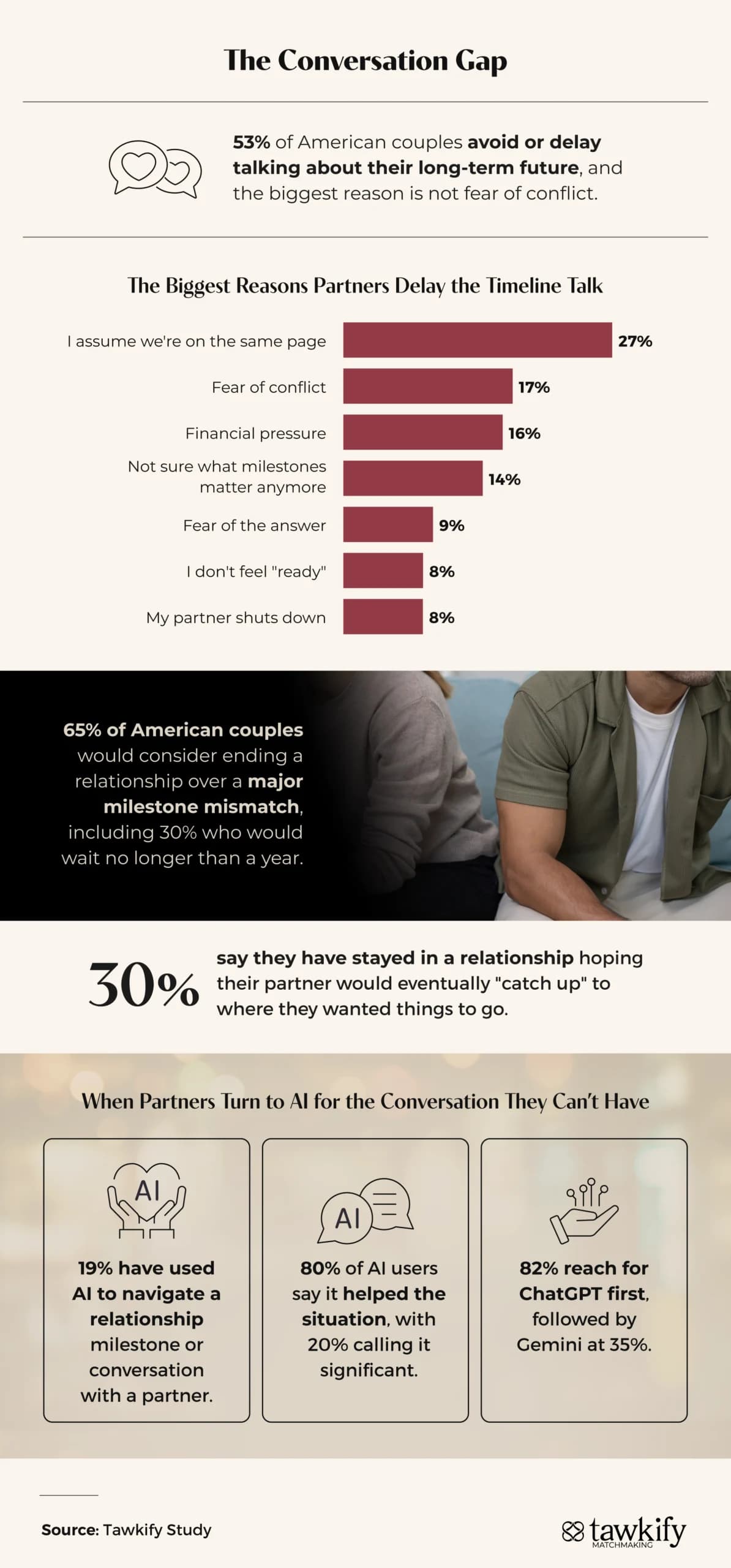
Most Americans said they would seriously reconsider a relationship if major future goals didn’t align. Overall, 65% said they would consider ending a relationship over a significant timeline mismatch. Gen Z respondents were especially likely to feel this way, with 80% saying they would walk away over incompatible timelines.
Older generations appeared more willing to tolerate differences in pacing. Only 55% of Gen X and 45% of baby boomers said they would consider ending a relationship over a major milestone mismatch. Waiting tolerance followed a similar pattern. Nearly one-third of Americans (30%) said they would wait no longer than a year for a partner to feel ready for a major milestone, but that jumped to 45% among Gen Z respondents. By comparison, only 23% of Gen X and 22% of Baby Boomers said they would leave within a year.
At the same time, Gen X respondents appeared most likely to stay in relationships hoping their partner would eventually catch up emotionally or practically. More than one-third of Gen X respondents (34%) admitted they had stayed in a relationship waiting for alignment rather than immediately walking away.
When Alignment Becomes the Real Relationship Goal
Modern relationships are no longer defined by one universal roadmap, and that may be especially true for people dating or partnering later in life. For Gen X and baby boomers, commitment may come with more lived experience, clearer priorities, and less interest in rushing major decisions simply because a timeline says they “should.”
The study revealed that older generations were less likely than Gen Z to end a relationship over a milestone mismatch, suggesting that patience and perspective may play a larger role in how they navigate love. But that doesn’t mean alignment matters less. Gen X respondents were the most likely to have stayed in a relationship hoping a partner would catch up, which shows how easily patience can turn into quiet waiting when expectations go unspoken.
For daters in their 40s, 50s, and beyond, the lesson may be less about following a traditional relationship path and more about naming what matters now. The strongest relationships may not be the ones moving fastest toward milestones. They may be the ones where both people are honest about what “next” means before silence fills in the answers for them.
Methodology
We surveyed 1,009 partnered Americans currently in a romantic relationship. Respondents spanned a mix of generations, genders, relationship lengths, and U.S. regions. The generational breakdown was 54% millennial, 23% Gen X, 18% Gen Z, and 6% baby boomers. Those who identified as women made up 57% of respondents, 41% identified as men, and 2% as non-binary or another gender identity. Data was collected in May 2026. Figures may not sum to 100% due to rounding.
About Tawkify
Tawkify is a personalized matchmaking service designed for singles seeking meaningful, long-term relationships. Unlike dating apps built around endless swiping, Tawkify pairs clients with experienced matchmakers who focus on compatibility, communication, and shared relationship goals. For people navigating questions around commitment and future alignment, Tawkify offers a more intentional path to connection.
Fair Use Statement
The information and findings in this article may be shared for noncommercial purposes only. If you reference or republish this content, please provide proper attribution with a link back to Tawkify.