Wasting Hours on Dating Apps? Matchmaking Is the Answer

Modern dating has never been more accessible, yet for many singles, it has never felt more exhausting. Between endless swiping, dead-end conversations, and first dates that were a poor fit from the start, the hours add up fast, and the payoff often doesn’t.
To understand what is happening behind the swipes, Tawkify surveyed 1,000 single adults across the U.S. We asked about their dating app habits, first date experiences, and openness to professional matchmaking. What we found points to a clear alternative for anyone tired of spending their time without finding a real connection.
In this article
Key Takeaways
- Singles spend nearly 11 hours a month swiping and messaging on dating apps, with 1 in 5 (20%) spending more than 20 hours/month.
- 39% of dating app users say the conversations on dating apps go nowhere most of the time, with Gen X singles being the most likely to report this (44%).
- 58% of users have taken a break from dating apps due to burnout, with Gen Z doing so the most (62%).
- 41% of singles would trust a human matchmaker over a dating app algorithm.
- Nearly 3 in 4 dating app users (73%) say swiping has made them feel like they were shopping for people rather than connecting with them.
The Hidden Tax of Modern Dating
The hours singles spend on dating apps add up fast, and for most, the return on that investment is disappointingly low.
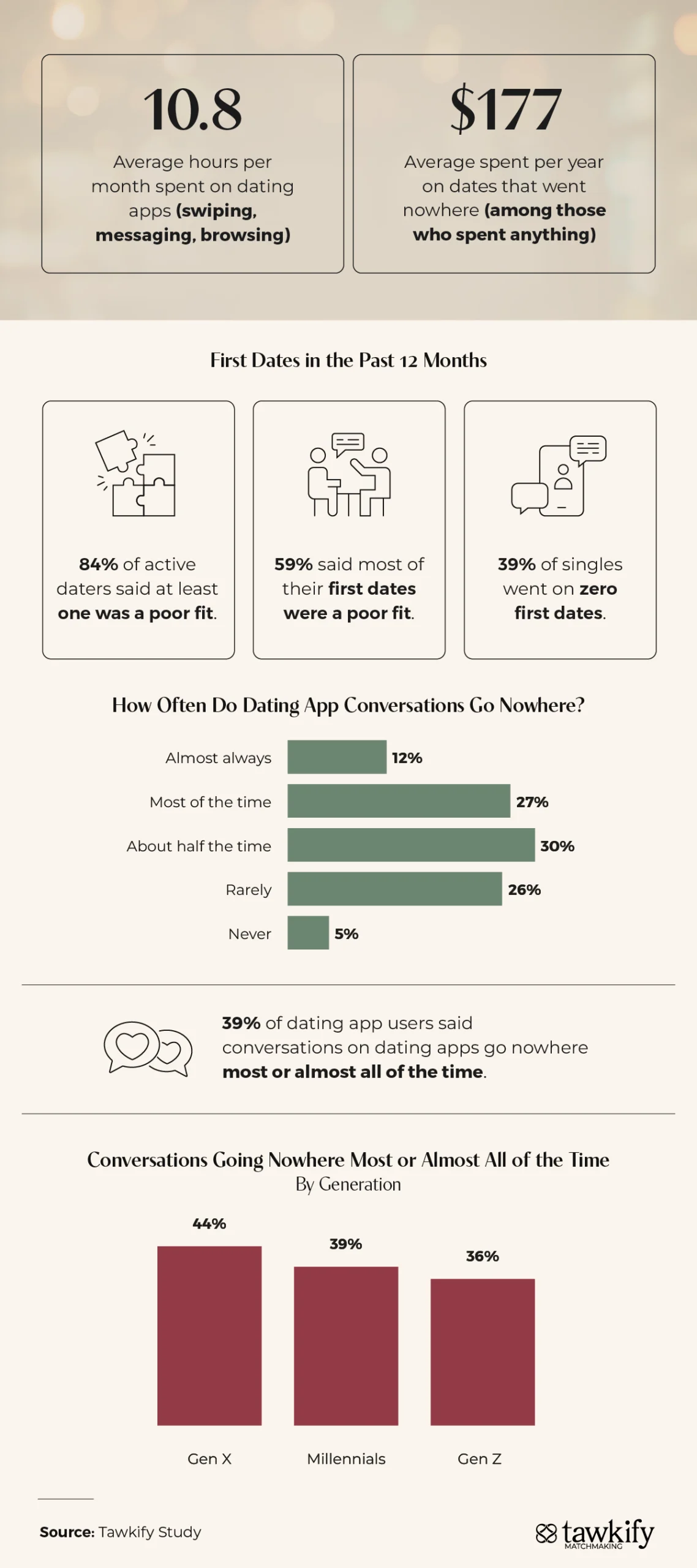
Dating app users spent an average of 10.8 hours per month swiping, messaging, and browsing profiles, and 1 in 5 (20%) spent more than 20 hours per month on these activities. More than half of all singles (51%) spent money on dates that did not lead anywhere in the past 12 months, with an average of $177 among those who did.
The first date picture was equally discouraging. Nearly 2 in 5 singles (39%) went on zero first dates in the past year. Among those who went on dates, 84% said at least one was a poor fit, and 59% said more than half of their first dates were poor fits.
Dead-end conversations compounded the frustration. Among dating app users, 39% said conversations on dating apps went nowhere most or almost all of the time. Gen X led all generations at 44%, compared to 39% of millennials and 36% of Gen Z, suggesting that the problem does not ease with age or experience.
When Swiping Starts to Hurt
The emotional weight of modern dating extends well beyond wasted weekends and awkward dinners.
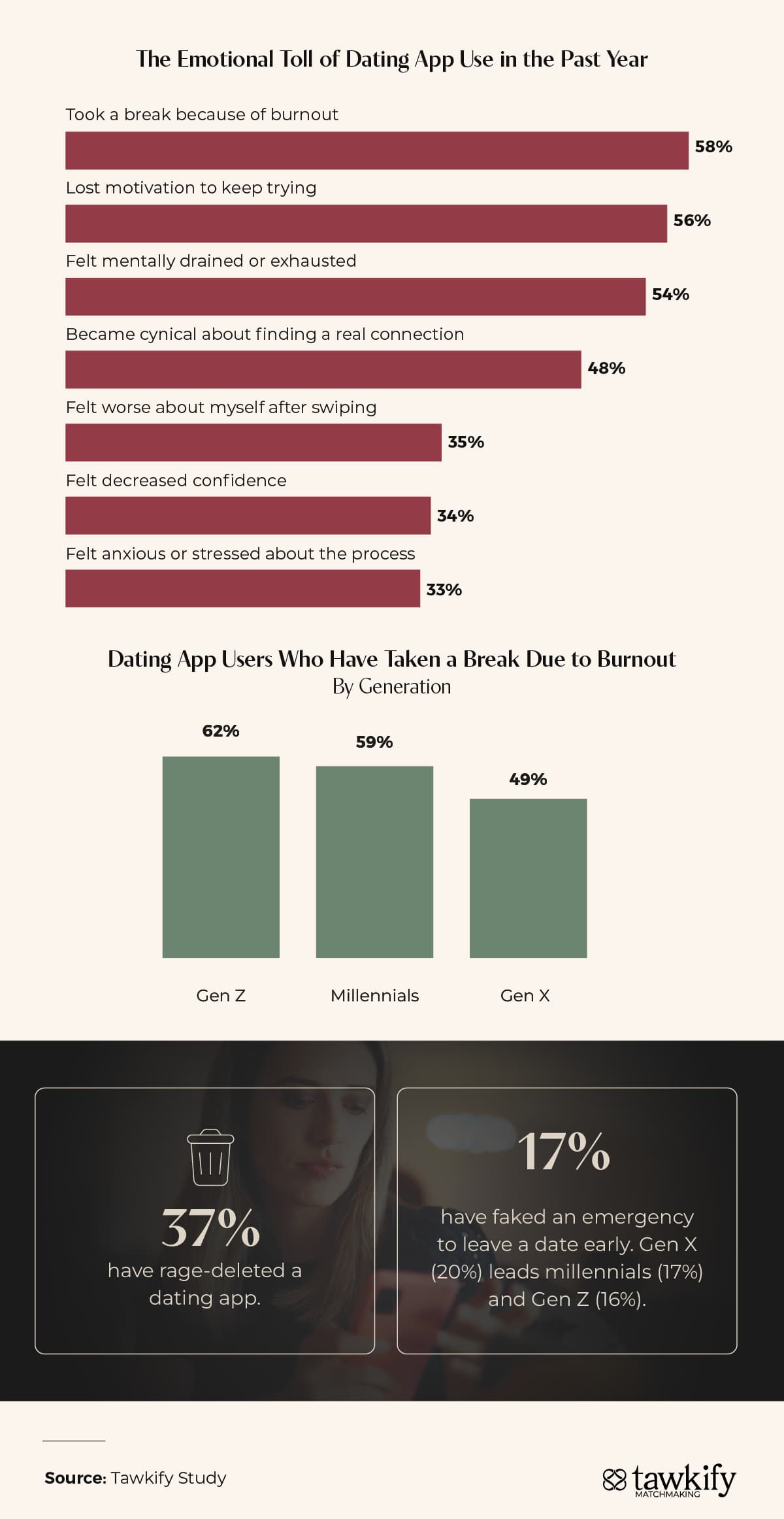
The most common emotional tolls reported by dating app users were taking a break because of burnout (58%), losing motivation to keep trying (56%), and feeling mentally drained (54%). Gen Z app users were the most likely to have stepped away entirely, with 62% reporting a burnout-driven break, followed by millennials at 59% and Gen X at 49%.
Nearly half of app users (48%) said they have become cynical or pessimistic about finding a genuine connection. Beyond that, 35% felt worse about themselves after a swiping session, and 34% reported decreased confidence, pointing to a pattern of self-doubt that builds over time.
The behavioral fallout was equally telling. More than a third of all singles (37%) had rage-deleted a dating app out of frustration. Meanwhile, 17% had faked an emergency to leave a bad date early, with Gen X (20%) edging out both millennials (17%) and Gen Z (16%).
The Case for Professional Matchmaking
After years of swiping, many singles are open to a very different approach. Matchmaking feels more personal and human, because it is.
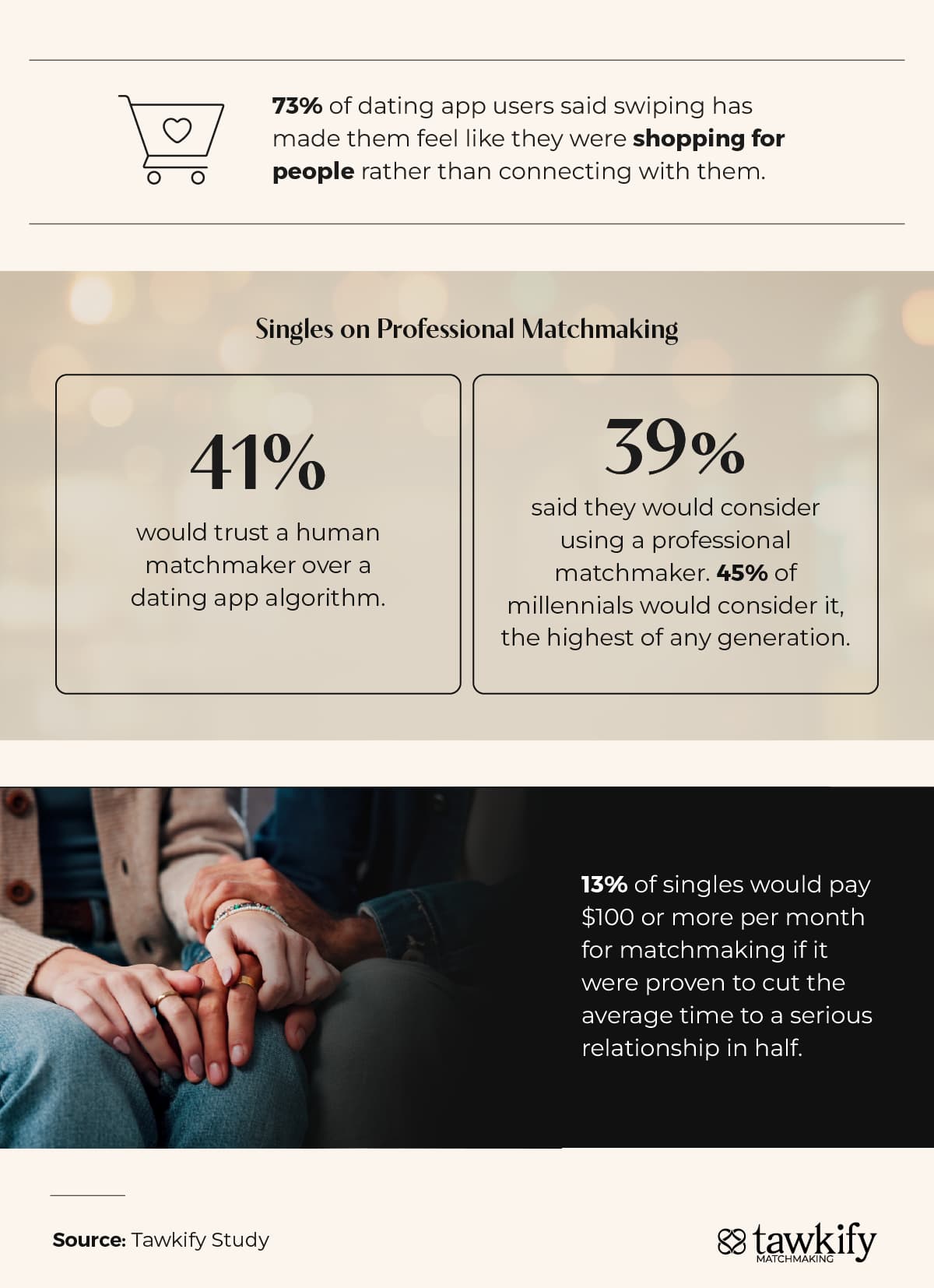
Nearly 3 in 4 dating app users (73%) said swiping has made them feel like they were shopping for people rather than connecting with them, a feeling that showed up across every generation. It’s no wonder, then, that 41% of singles said they would trust a real matchmaker to choose their next date over a dating app algorithm. Millennials were especially ready for the shift, leading every generation in openness to working with a professional matchmaker (45%).
What’s driving the interest isn’t just fatigue. Singles want a smarter, more intentional way to date, one that trades hours of guesswork for matches chosen with real compatibility in mind. For those who are serious about finding a partner, that kind of focus is starting to feel less like a luxury and more like the obvious next step.
More than 1 in 10 singles (13%) said they would pay $100 or more per month for matchmaking if it cut the average time to a serious relationship in half. This figure reflects genuine demand among those who are serious about finding a partner and frustrated with how long the current system takes.
When you’re looking for a relationship, there’s no comparison
Tired of swiping with no real connections? Tawkify takes a fresh approach to the process. With handpicked matches tailored just for you and personalized introductions, we do the work so you can focus on what matters — meaningful connections.
- 80% of people find success with Tawkify
- 3 Million+ relationship-ready singles
- 200,000 Successful connections and counting

Dating Smarter, Not Harder
If the hours, burnout, and dead-end conversations are starting to feel like too much, the good news is that swiping isn’t the only path to a real connection. Professional matchmaking flips the script by leading with compatibility, the thing that actually lasts.
With Tawkify’s expertly selected matches drawn from a private network of more than 3 million relationship-ready singles, you can spend less time scrolling and more time meeting people who are genuinely worth your time. Dating smarter, not harder, might be exactly the change you’ve been waiting for.
Methodology
We surveyed 1,000 single adults in the United States in 2026. Respondents were 52% women, 44% men, 3% non-binary, and 1% preferred not to say. Generationally, the sample comprised 46% millennials, 34% Gen Z, 16% Gen X, and 3% baby boomers. Some questions were asked only of respondents who reported using at least one dating app in the past 12 months. For questions that allowed respondents to select more than one answer, percentages reflect the share of respondents who selected each option and will not sum to 100. Dollar figures and time estimates reflect IQR-adjusted averages to account for extreme values.
About Tawkify
Tawkify is a personalized matchmaking service that connects singles with a dedicated matchmaker who gets to know them, curates compatible introductions, and provides feedback after every date. Unlike dating apps, Tawkify puts human judgment and genuine care at the center of the process, making it a strong fit for singles who are ready to stop swiping and start meeting people who are right for them.
Fair Use Statement
The data and findings in this article may be used for noncommercial purposes only. Any use or republication of this content must include an attribution to Tawkify along with a link to the original article.