When Work Gets in the Way of Love: The Career Chemistry Report


Most people don’t think of their job as a relationship factor until it starts creeping into dinners, weekends, and quiet moments at home. Work can change how present we feel, how supported we feel, and how close we stay to the person we care about.
To better understand how careers shape modern relationships, Tawkify surveyed over 1,000 Americans across generations, industries, and family situations about love, stress, and compatibility. What they shared reveals how work influences who we choose, who we stay with, and why some relationships struggle to keep up.
Key Takeaways
- 1 in 3 Americans said career compatibility is important in a relationship.
- 33% of Americans would end an otherwise great relationship over a career mismatch, with Gen Z leading at 44%.
- Gen Z is nearly 2x as likely as baby boomers to walk away from a great relationship over career incompatibility (44% vs. 24%).
- Women are 3x more likely than men to reject a partner for making less money (32% vs. 9%), but both genders happily date up.
- Nearly half of Americans (47%) admit work stress makes them irritable, distant, or withdrawn with their partner.
- 53% have hidden or downplayed work stress to avoid damaging their relationship.
- 43% of Americans say bringing work stress home causes the most relationship tension.
In this article
When Careers Clash, Time Wins
Career compatibility sounds abstract until you’re trying to plan dinner, weekends, holidays, and the rest of your actual life. The big friction points weren’t subtle. They were the kinds of mismatches that quietly turn “us” into two separate schedules.
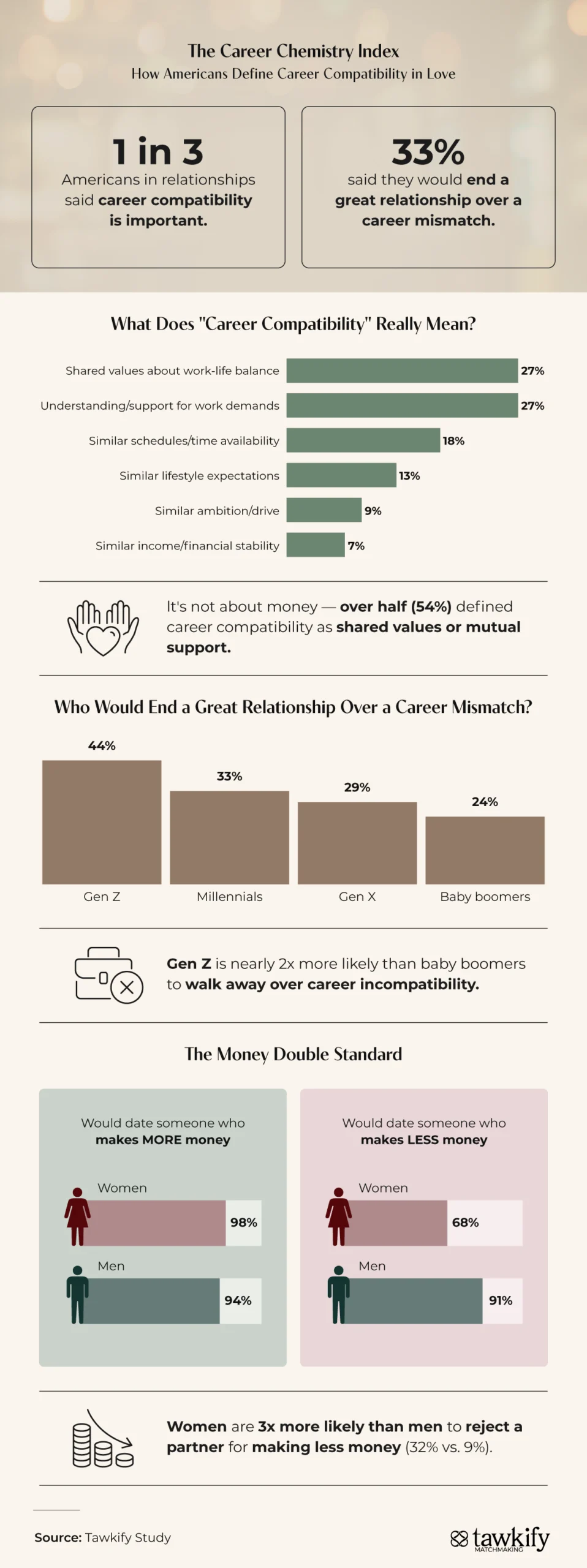
One-third of Americans in a relationship said career compatibility between partners is important. Industry rankings show career fit matters most to people working in:
- Technology/IT
- Professional services
- Construction/trades
Parents with kids under 18 said career compatibility was important at a higher rate (39%) than non-parents (28%) and parents of adult children (23%). For long-term relationship success, respondents ranked shared work and life values first (50%), followed by flexibility (27%), schedules (17%), and ambition (6%).
When respondents looked at career contrasts that made relationships harder, time-related issues clearly outweighed everything else:
- One partner working nights or odd hours (60%)
- Frequent travel (58%)
- Being consistently on-call (48%)
These pressures created more strain than differences in stress levels (32%), work flexibility (21%), job prestige (11%), or work-from-home status (8%).
Another 33% of people said a career mismatch alone would be enough to end an otherwise great relationship. This was most common among Gen Z (44%), who were nearly twice as likely as baby boomers (24%) to say they would do so. The top dealbreakers among those who would call it quits were:
- Completely opposite work schedules (43%)
- One partner being “married to the job” (39%)
- Mismatched ambition or drive (27%)
- Clashing values (26%)
- Financial stability mismatches (24%)
- Unpredictable on-call work (16%)
- Frequent travel or relocation requirements (16%)
Workers in technology/IT, education, and healthcare were the most likely to say they’d end a relationship over a career mismatch.
Career compatibility didn’t just matter inside relationships. It also shaped who got a real shot in the first place. More than a quarter of Americans (28%) said they had ruled out a potential partner primarily because of their career situation. Among those who did so, their top reasons were:
- Job instability or inconsistent income (39%)
- Worry about carrying more responsibilities (27%)
Gen Z reported the highest rate of rejecting a partner due to career factors (33%), followed by millennials (30%), Gen X (25%), and baby boomers (19%). Women were also 32% more likely than men (9%) to reject a potential partner for making less money than they did.
Work Stress Doesn’t Stay at Work
Most couples aren’t arguing about the job itself. They’re arguing about the version of their partner that the job creates. Stress has a way of showing up in tone, attention, and patience long before anyone says, “We need to talk about work.”
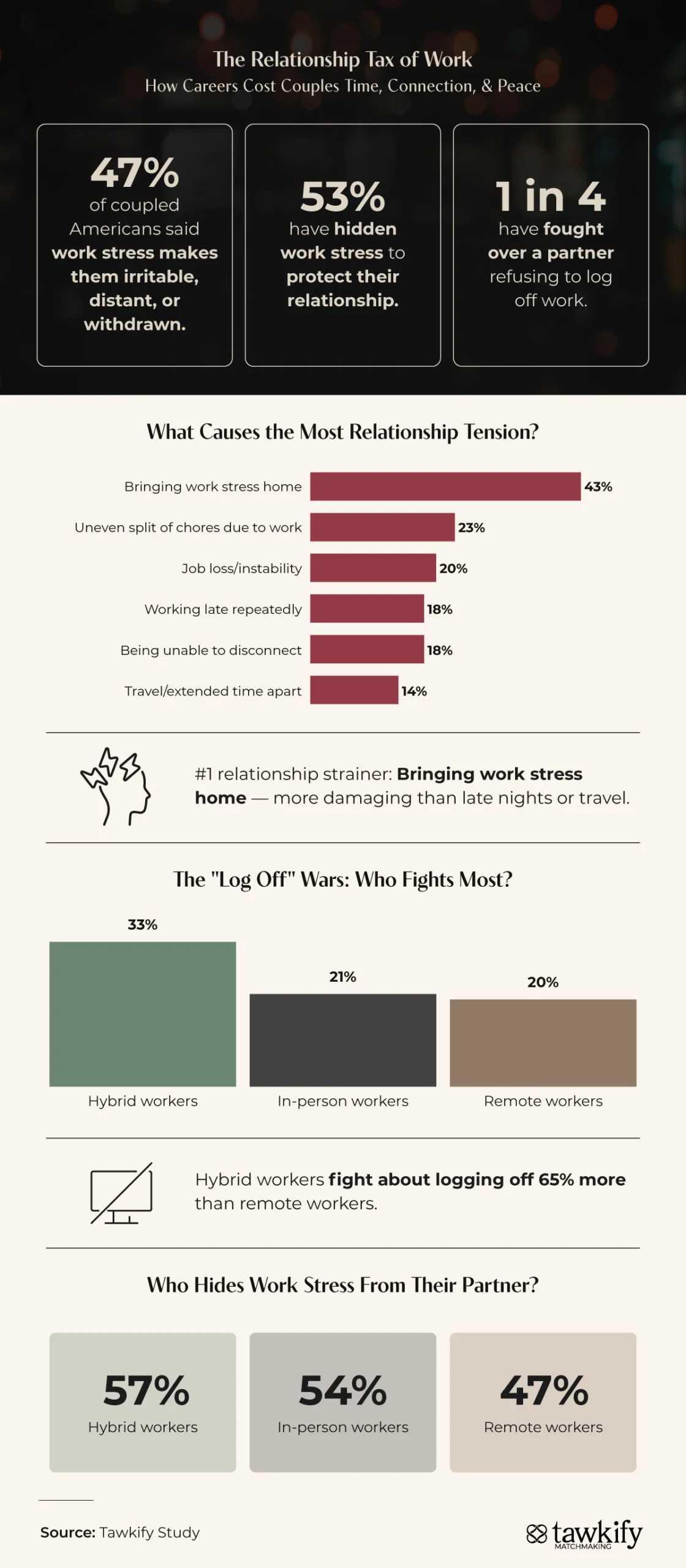
Work stress most often showed up as emotional drift. Nearly half of coupled Americans said work stress made them irritable, distant, or withdrawn at home (47%). Hospitality, finance, and tech workers were the most likely to report these effects. Far fewer respondents said they could truly compartmentalize work stress and keep things steady (24%), while others reported:
- Becoming more irritable or short-tempered (23%)
- Leaning on their partner more for support (18%)
- Going quiet or withdrawn (17%)
- Becoming less emotionally available (8%)
- Getting clingy and seeking reassurance (6%)
Overall, 43% said bringing work stress home causes the most relationship strain. A lot of people tried to “protect” the relationship by holding it in. More than half (53%) said they had hidden work stress to avoid hurting their relationship. This behavior was most common among people in:
- Media/marketing/creative
- Healthcare
- Technology/IT
Boundaries were another flashpoint. A quarter of respondents said they had fought over a partner refusing to log off. Parents of kids under 18 reported the highest rate of these “log off” fights (31%), compared to non-parents (18%) and parents of adult children (15%), suggesting that when work competes with family time, tensions rise fast. Gen X (27%) and millennials (26%) were three times more likely than baby boomers (9%) to fight over logging off.
Some respondents felt they were competing with a job for attention. One in five said their partner sometimes or definitely cared more about their job than the relationship (20%), while most said their partner did not prioritize work over them (80%).
When people described what would improve their relationship, they wanted:
- Better financial stability (36%)
- More time together (27%)
- Less work stress (16%)
Clearer boundaries around logging off (5%) and more predictable schedules (5%) came in lower, but they still pointed to the same craving. Less chaos, more steadiness.
When you’re looking for a relationship, there’s no comparison
Tired of swiping with no real connections? Tawkify takes a fresh approach to the process. With handpicked matches tailored just for you and personalized introductions, we do the work so you can focus on what matters — meaningful connections.
- 80% of people find success with Tawkify
- 3 Million+ relationship-ready singles
- 200,000 Successful connections and counting

Money, Sacrifice, and the Quiet Scorekeeping That Builds Over Time
Resentment in relationships usually happens through small defaults, such as whose job gets protected, whose job gets flexible, and whose goals get put on hold.
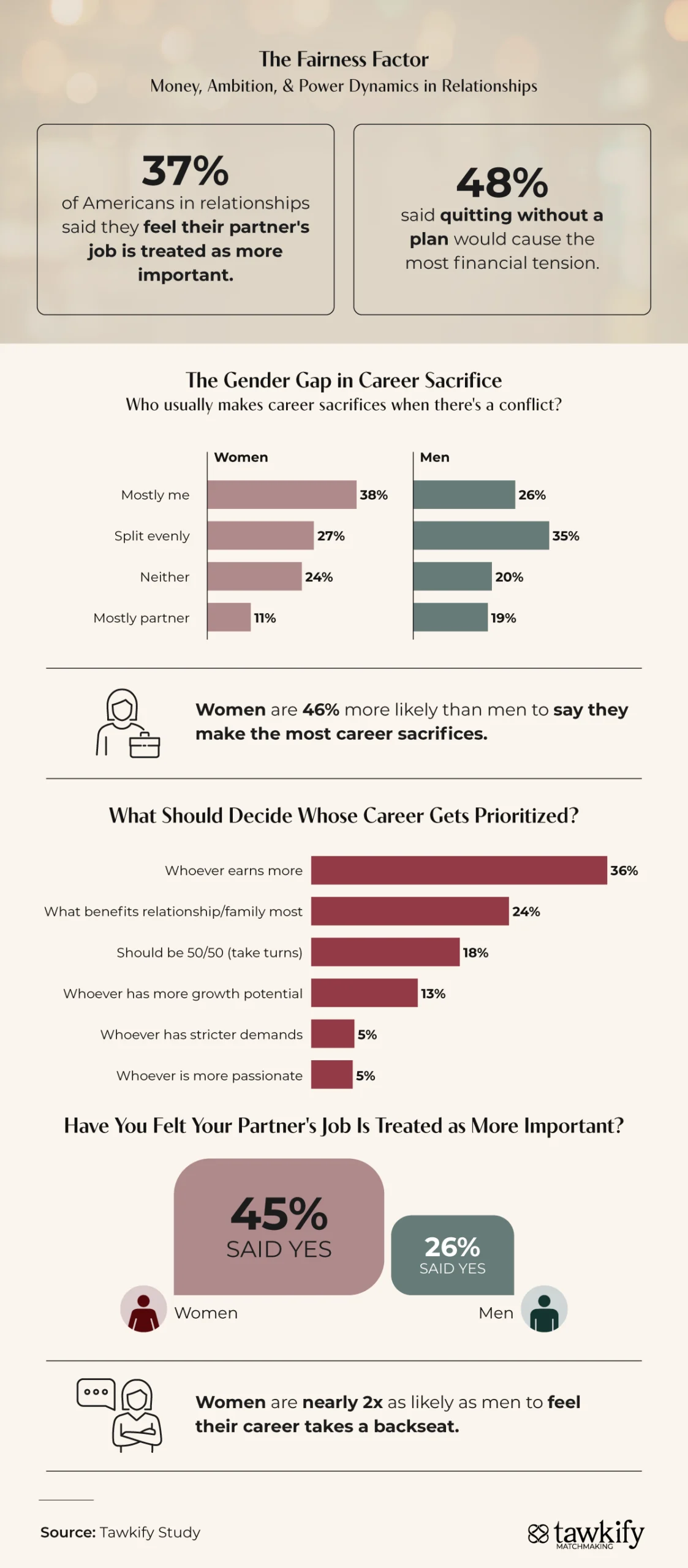
Most people believed they handled career compromises with their partner fairly (71%), but 1 in 10 felt “the system” was stacked against them, a kind of imbalance that can simmer for years.
Sacrifice wasn’t evenly felt. Women reported making most career sacrifices in their relationships more often than men (38% vs. 26%). Career resentment was also part of the picture. A meaningful minority (13%) said they had resented their partner’s career for holding them back, and women reported this more than men (15% vs. 10%).
More than a third of Americans in relationships (37%) said they felt their partner’s job was treated as more important. Some of the biggest differences were tied to context:
- Parents of kids under 18 were more likely to feel their career took a backseat to their partner’s than non-parents (41% vs. 32%), while parents of adult children landed slightly lower (31%).
- Fully remote workers (43%) were more likely to feel their partner’s job was treated as more important than theirs, compared to hybrid (35%) and fully in-person workers (33%).
- Those working in media, education, and retail were most likely to feel their own work came second in their relationship.
When people named the financial scenario most likely to cause relationship tension, the biggest threat wasn’t an income gap. One partner quitting without a plan ranked highest (48%), followed by:
- One partner refusing to discuss long-term financial goals (14%)
- A big career shift, like a pay cut or job loss (11%)
Earning significantly more or less than the other sat at the bottom, at 8%. Twenty percent said none of these factors would cause tension because they were “financially chill.”
Despite how loaded these topics are, many couples don’t often talk about them. Only a small slice said they “very often” discussed money and career expectations (11%). The most common answer was “sometimes” (45%), and a notable share said they rarely or never discussed it (14%).
What Career Chemistry Really Comes Down To
Taken together, the findings point to something simple but often overlooked. Most people aren’t asking for perfectly matched resumes or identical ambition levels. They’re looking for steadiness, shared values, and enough time and emotional space to actually enjoy being together.
When work supports a relationship, it tends to fade into the background. When it doesn’t, it quietly shapes decisions about who feels prioritized, who feels stretched thin, and whether a relationship can grow over the long haul.
Methodology
Tawkify surveyed 1,003 Americans in committed relationships or marriage to explore how career compatibility, work stress, and professional dynamics affect their relationships; 71% of respondents were married, while 29% were in committed relationships. The gender breakdown was 55% women and 44% men. Generationally, the sample consisted of 56% millennials, 26% Gen X, 11% Gen Z, and 8% baby boomers. Respondents were also segmented by income, industry, work arrangement (remote, hybrid, in-person), and parental status. Some percentages in this study may not total 100% due to rounding.
About Tawkify
Since 2012, Tawkify has revolutionized the matchmaking industry by blending human intuition with data-driven insights. With a private database of over 1 million people and a track record of more than 200,000 successful matches, Tawkify offers a personalized, expert-guided alternative to today’s dating scene. Tawkify matchmakers handle everything from finding potential matches to planning unique and engaging dates, empowering clients to focus solely on building genuine connections.
Fair Use Statement
If you’d like to share this data for noncommercial purposes, please include proper attribution with a link back to Tawkify.